
// Synopsis
Drone Commander is a hybrid Visual Novel / RTS / RPG game that dynamically alternates between gameplay modes to keep the experience varied and cinematic. Players engage in story-driven conversations, tactical real-time strategy battles, and explore RPG-style sections with character interaction and minigames.
The player, an ordinary human, is abducted into a galactic conflict involving several alien factions and an ominous, destructive Type 3 drone fleet. Initially seen as primitive, the player gradually gains influence by showing an uncanny ability to control drones and coordinate defense strategies.
The player's fleet, called the Vanguard, is on the run from the drone fleet while rescuing alien races and occasionally launching counterattacks. Humanity has only recently begun to advance technologically after surviving a near-catastrophic drone attack. Characters have rich backstories and personality-driven arcs, and the choices you make shape alliances, friendships, rivalries, and even romance.
Gameplay Modes
- VN Mode: Storytelling, dialogue trees, choices with consequences
- RTS Mode: Command fleets, deploy drones, manage shields, formations, and superweapons
- RPG Mode: Explore ships and alien planets, interact with crew, complete quests, and engage in pixel-art shooter combat
- Minigames: Crew hiring, job assignment, research progression, morale tracking, fleet economy management
Tone & Themes
A balance of emotional storytelling, sci-fi mystery, and tactical warfare. Explores themes of identity, trust between species, power, and redemption. Blends anime-style drama with strategic gameplay and rich lore.
// Story Roadmap (Planning)
⚠ Heavy spoilers — living planning document. This is the developer's act-by-act workflow for the whole game: the rough beat order, the open problems, and the options being weighed. Everything here is provisional and changes as the design firms up.
Act 1 — Saving Earth
- Straker abducted
- Explore the Freexyl
- Rhyzark flees, the Bot Rebellion, the waking of Tiff, the Final Nightmare, Drunmuire, Albion's Anchor
- Arrival of Neph / the Invasion
- The Vanguard Special Mission Group: 12 missions — the introduction of the FOM
- The Drone Fleet arrival
- Battle for Earth
Act 2 — Mirelexia
- Travel to Mirelexia
- Travel to the metropolis — the Nobility (peasants)
- Explore the jungles — revelations
- Task Force Black / Black Fleet hidden missions
- The Drone Commander
- Temple Battle: a battle in the Honnehari Temple against the Morrigan… and a massive giant ethereal being, Ivrixia. Ends with Ivrixia offering to be a knowledge compendium for you whenever you meet her in a Temple — but she does not join your team. She tells you about the deep power of this star system, the sun, and how it can be used as a weapon to stop the Drone Fleet.
- Locked in: you do not fight against Daria in this act, and you do not have Rexalia on your team.
- Preparation Missions — humans, Sekarri and Mirelexians work together to activate the space-bound artefacts Ivrixia described
- Liberation of Mirelexia Prime — battle with the Drone Fleet. The star/sun uncloaks them for a slight advantage, but unlike Earth this erupts into a full-on space battle with the Drone Fleet harbingers
Act 3 — The Black Fleet
Here your decisions have a huge impact: you can join the Black Fleet, or reject them and stay with the Vanguard.
- Black Fleet Space Battle: Black Fleet encounter against Morrigan's forces. Win, and she asks you to leave and join her. Lose, and you're captured — you can choose to stay or escape.
Going to the Black Fleet
- Do all Black Fleet missions — meet Gia, Makara, Vess etc.
- Special Missions: Finding Daria
- Special Missions: XXXX (super secret)
- QTE events to play as Straker, so you see what you're missing on the Vanguard side.
- Also on this path: loot planets that are victimising other races; war with the Kethri factions; help Vess recruit more humans; final battle; tearful return to the Vanguard.
Staying with the Vanguard
- Every milestone mission, Morrigan texts you to give you the chance to switch teams.
- Every milestone you miss, you get a QTE option to play that event as Brian (the Straker-like character on the Black Fleet).
- You get to play the Kethri Discovery Missions.
- Meeting the Annunaki — you can only romance her if you stay with the Vanguard.
- Meeting Snow.
- Meeting Garland.
Either way, nothing is fully missable: stay with the Vanguard and you'll still meet Gia, Makara, Vess etc. later — but with a reduced chance to build relationships. Join the Black Fleet and you'll still get the chance to meet Snow, Garland and the Annunaki — likewise with a reduced chance to build relationships.
Act 4 — The Kethri
- The Kethri home world; the Annunaki & the Undead-Annunaki.
- Critical plot point 1: your first major loss as the Vanguard.
- Critical plot point 2: a partial coming together of the Vanguard and the Black Fleet — your chance to meet the characters you didn't meet on your chosen Act 3 branch.
Act 5 — Shal, the Deritonians & the Drakhans
- Travel to Shal (formerly "Fortress Deep" in earlier drafts) — home world of the Deritonians & Drakhans.
- Negotiations…
- Ends with the Drakhans giving Straker the coordinates and the Amulet that lead into the Vionite arc (see Meeting with the Vionies).
Act 6 — The Vionites & Daria
- Vionites — first formal contact with the Vionite Empire (see Meeting with the Vionies).
- Daria's arc lands here — deferred from Act 2 so the Vionites and Honnehari don't have to be explained too early.
Act 7 — The Honnehari
Act 8 — The Final Showdown
- The Skrill and the final fight
Loose Ends to Fix
Solved. How much do your interactions with the Honnehari influence your first meeting? — they don't believe you met them.
Solved. Evil faction: the Committed. You now fight them after meeting Ozerane, not early on when defending Earth.
Solved. Problem 1 — Black Fleet interactions. If you stay with the Vanguard all the way: Morrigan texts you at every milestone with the chance to switch, missed Black Fleet events are playable as Brian via QTE, and the partial Vanguard/Black Fleet coming-together in Act 4 lets you meet everyone you missed — just with a reduced chance to build relationships.
Solved. Problem 2 — timing of Daria & Rexalia. No Daria fight and no Rexalia in Act 2. Daria is found via a Black Fleet special mission in Act 3, and her arc lands in Act 6 alongside the Vionites — so the Vionites and Honnehari no longer need explaining early.
Permutations
- 1. You find Rexalia, the Black Fleet find Daria, then you face off over Ivrixia. Con: unveils too many characters too early.
- 1b. As above, but you face off in the core of Mirelexia and Ivrixia comes later.
- 2. You don't find Rexalia or Daria until after your first meeting with Ozerane. The battle for Ivrixia ends without you obtaining her just yet — she acts as a remote advisor. So this standoff is for the core of Mirelexia; then, after meeting Ozerane, you can meet Daria and Rexalia independently.
Current Favoured Approach
Now largely baked into the act-by-act outline above — kept here for the reasoning trail.
- Mirelexia — fight for Ivrixia against the Black Fleet (no Daria, no Rexalia).
- Result: Ivrixia becomes a remote advisor only.
- Later you'll have more run-ins with the Black Fleet.
- Meet Ozerane, get rejected — then you race to find Rexalia.
- Separate story: you play as Brian (a Straker-like character on the Black Fleet) as you also race to find Daria and unlock her.
- The Black Fleet arrive where Rexalia is, to find her joined with the Vanguard.
- Final face-off… but both sides begin to waver, having had many run-ins and starting to see they're on the same side.
- The Committed attack Earth — you both race to stop them.
// Drones
The word drone carries two meanings in this universe, and you'll meet both. Drone Commander is — at its core — a game about drones, so it's worth getting the distinction straight before going any further.
Combat Drones — Personal & Tactical
The first kind are personal combat drones: small autonomous weapons and support units that fight alongside you on the ground or in close quarters. These include modern human FPV drones and the hovering Sekarri assist drones that escort their operators into battle. More types are planned, and the roster will keep growing.
- FPV Drones (Human-made) — Modern-day style drones called in for air strikes, grenade drops, ammo drops, puzzle-solving and more.
- Basic Sekarri Drone — A defence-shield drone that soaks hits for its operator and returns fire with electron bolts. Can be levelled up.
- Medic Drone — Heals allies and revives those who have been incapacitated.
- Kethri Biological Drones (planned) — Living drones grown rather than built.
- Vionite Drones (planned) — Resonance-attuned drones aligned with the Vionite essence framework.
Autonomous Vehicles — Drone Ships
The second meaning is far larger in scale. Drone vehicles are autonomous space-going craft — battleships, scouts, beamships and everything in between — piloted remotely rather than crewed in person. The Sekarri practise a hybrid form of space warfare in which most of their fleet is run this way, by drone pilots of varying specialism.
The Tether and the H-Pod
A Sekarri pilot connects to their ship (or ships) in two stages:
- The Tether — A partially biological Sekarri neural implant fitted in childhood. It is the lifelong connection point through which a pilot's mind reaches outward.
- The H-Pod — Sensory-deprivation rigs of varying design that fully lock a pilot in for more complex tasks. Some H-Pods are flooded with an amniotic-style fluid, leaving the pilot floating while connected.
For humans, the Drone Pilot Program — a joint effort by Kira, the digital Sekarri native Amu, and Evren — adapted the technology so non-link users could connect at all. People like Straker use modified H-Pods to fly Sekarri craft despite having no Tether of their own.
Drone Pilot Ranks
| Rank | Role |
|---|---|
| Drone Pilot | Remotely flies a single ship, usually a fighter. |
| Drone Specialist | Pilots a more complex ship or a small group of ships. Requires extra training, experience and mental compatibility. |
| Drone Hub Controller | Manually pilots a Drone Hub — a highly stealthed transmission vehicle that some pilots live aboard, kept within broadcast range of their fleet. Hub Controllers fly manually in the event of mass jamming. |
| Drone Coordinator | Like Tabby: connects via H-Comms to mentally link every pilot under their wing, relaying navigation hazards, enemies and commander instructions. Decides what is priority and conveys it in human (or Sekarri) terms — an additional layer above the usual information systems. |
| Drone Commodore | Experienced enough to coordinate multiple drone vehicles at once — not just a battleship and its fighter escort, but entire battle wings. |
The Mirelexian Drones — Legend of the Original Commander
For the Mirelexians, "drone" means something else again. Bipedal, multi-armed, insect-like humanoids living in a split corporate-aristocracy society at roughly modern human technology level, they keep an old legend about the original Drone Commander — a warrior who saved their people from extinction by learning to fly the giant wasp-like flying beasts they call drones.
Deadly and hyper-aggressive, those drones were turned through hormone warfare and other arts; the Commander tamed them, rode one into battle, and changed the course of the war. Many Mirelexian sects still believe his return is bound up with their own survival — and with the beasts' original (largely docile) nature, much like Earth's modern drones.
The Drones of the Drone Fleet
Finally there are the Drones of the Drone Fleet — better known as the Dark Worlders. The name is a misnomer: very little is known about them at all, except that they descend on the galaxy as a vast, seemingly unbeatable conquering force, reduce it to rubble, and depart — only to return generations later for another culling.
// Gameplay
RTS — Base Building Guide
Welcome, Commander. Space strategy games have a terrain problem. Without hills, chokepoints, or rivers, battles devolve into blobs smashing into blobs in an empty void. Asteroids only get you so far.
Drone Commander does something different. Instead of importing ground-war mechanics into space and hoping they stick, we built a strategy layer native to orbital combat — one where the battlefield has structure, territory, and depth without a single wall or turret line. Everything you build, everything you fight over, is rooted in the science-fiction of the universe itself.
This guide walks you through how base building works, what you’re managing, and why it all matters.
Your Fleet: Three Ships, One War
You don’t build a base in Drone Commander. You deploy a fleet. Your operations run through three capital ships, each with a distinct role. Think of them as your economy, your brain, and your fist.
The Command Ship
This is your nerve centre. Everything starts here. When you deploy the command ship at the start of a mission, your first move is to fire up the Nanite Forges — internal reactors that passively generate energy. You’ll start with three, and they’ll quietly tick away, filling your energy reserves while you figure out your opening strategy.
Energy is the gating resource for everything else. You spend it to unlock departments — the four operational branches that open up your options:
- Mining Operations — unlocks harvesters (for ore), enticers (for preparing void matter extraction), and void harvesters
- Engineering & Prospecting — unlocks surveyors (for research points) and the ability to research drift projectors
- Defence Industry — lets you mount turrets, shield generators, and other defensive systems directly onto your ships
- Cyber Warfare — opens up a suite of offensive and defensive digital attacks, but it’s the most expensive department to enable, making it a deliberate mid-to-late game commitment
You can’t unlock everything at once. At roughly 10 energy per second from three forges, your first department takes about 20 seconds to come online. That’s 20 seconds of defending with whatever you arrived with while you decide: do I go for economy first, or territory, or defences?
That tension never goes away.
The Research Ship
Your upgrade platform. The research ship doesn’t build combat units — it makes everything else better. Fleet-wide damage boosts, armour upgrades, engine speed, harvesting efficiency, drift field improvements — it’s all here, and it all costs research points.
The research ship is also where you unlock the blueprints for advanced units like the Dampener Ship and the entire cyber warfare tech tree.
Every RP you spend here is an RP you’re not spending somewhere else. Want to go all-in on cyber warfare? That’s 265 RP for the full tree — RP that could have gone to weapons upgrades, drift field efficiency, or dampener blueprints. The research ship is where your long-term strategy takes shape.
The Assault Carrier
Your war factory. The assault carrier builds all your combat ships — fighters, raiders, beam ships, missile frigates, battleships, shield ships, and heavier capital-class vessels like the Arkhelion.
Before you can build most unit types, you need to research them on the assault carrier (which costs energy), then deploy a construction field — a platform within a set radius of the carrier where your units are actually assembled. You also set a rally point so completed ships automatically disembark clear of the build zone.
The actual building is handled by constructors — small utility ships that pick up ore and energy from the command ship, fly over to the construction field, and spend those resources assembling the unit. Fighters are the exception — they don’t need constructors and can be produced directly.
As the game progresses, you can unlock additional construction fields to increase your throughput. More fields mean faster fleet replacement, which matters when you’re losing ships in a contested drift zone and need reinforcements now.
The Economy: Four Resources, One Loop
Energy
Generated passively by nanite forges on the command ship. Used to unlock departments and research unit types. You don’t need to micromanage it — the forges tick away on their own — but you do need to decide when to spend your reserves, because unlocking a department at the wrong time means you’re sitting without energy when something more urgent comes up.
Ore
The workhorse resource. Ore funds almost every unit and structure in the game. Harvesters fly out from the command ship to mining zones near the planet below, descend to the surface, collect ore, and return to deposit it. The mining zones drift across the map as the planet orbits, so your harvesters are constantly adjusting their routes — you can’t just park them and forget.
Research Points (RP)
Generated by surveyors — ships you build at the command ship and then deploy to research zones scattered across the map. Once a surveyor is in position, it passively generates about 1 RP per second by scanning the local environment. You can station up to two surveyors per zone.
RP is the currency of strategic choice. It buys drift projector research, cyber warfare unlocks, fleet-wide upgrades, and advanced unit blueprints. You never have enough, and every spend closes a door somewhere else.
Void Matter
The most interesting resource in the game — and the one that ties everything back to the lore.
To get void matter flowing, you first build an enticer and send it to a null field on the map. The enticer prepares the null field for harvesting (about 30 seconds). Once it’s ready, you deploy void harvesters to extraction points within the field, and they begin pulling void matter.
Void matter is what sustains your drift fields — the territorial hex network that forms the backbone of your defence. Every active drift projector drains about 1 void matter per second. Run out, and your fields start going dark. This means void matter income isn’t optional — it’s the lifeblood of your territorial presence.
Drift Fields: Your Terrain in Space
This is the heart of Drone Commander’s RTS identity.
The Problem
In a ground-based RTS, terrain does the heavy lifting for strategic depth. Mountains funnel armies. Rivers create chokepoints. Walls and turrets form layered defences that attackers must chew through. None of that exists in space.
The Solution
The entire map is divided into a honeycomb grid of hexagonal zones. At the start of a mission, this grid is invisible. When you build and deploy a drift projector into a hex cell, that cell activates — visually distinct, owned by you, and projecting altered physics within its boundaries.
Inside a friendly drift field, your ships gain a combat advantage: increased speed and increased firepower. Inside an enemy drift field, your ships are debuffed. The fields don’t block movement — any ship can fly into any hex — but the further you push into enemy territory, the more the odds stack against you.
This is what replaces walls and turrets. One enemy drift field is manageable. Three in a row, each stacking debuffs on your fleet while buffing theirs, is a meatgrinder. You’re not breaking through a gate — you’re fighting uphill through increasingly hostile physics.
Chains and Networks
Drift projectors don’t work in isolation. Every active projector must trace an unbroken chain of friendly hexes back to your command ship. The command ship is the power source. If a projector in the middle of your chain gets destroyed, everything beyond it goes dark — no buff, no debuff, just neutral space.
This is where the real strategy lives. A wide, shallow network is resilient but offers weaker coverage. A narrow, deep one projects power but is brittle — one surgical strike on a junction hex and half your network collapses. You’re constantly making decisions about network shape, and the enemy is always looking for the load-bearing hex to knock out.
Managing the Grid
Each drift projector has a manual on/off toggle. Mid-battle, you might shut down rear hexes to conserve void matter for the front line, or go dark on a flank to consolidate resources for a decisive push. You can also reclaim any drift projector — destroying it instantly and recovering some void matter — to reposition your network on the fly.
Breaking Through
When attacking into enemy drift fields, you’ll want a Dampener Ship — a specialist unit that reduces the debuff effects of enemy drift fields within a radius around itself. Dampener ships require significant RP investment to unlock (70 RP across two research tiers), but without them, pushing through deep enemy networks is brutal.
The Science Behind the Strategy
Here’s what makes Drone Commander’s base building more than just mechanics.
Strange Matter and the Ancient Gold Rush
Billions of years before the events of the game, ancient races noticed something extraordinary: the Cosmic Microwave Background Radiation — the echo of the Big Bang — wasn’t perfectly uniform. In twelve locations across the galaxy, CMBR appeared to clump together. When they investigated, they discovered that in these regions, the fundamental constants of the universe were different. The speed of light, the permittivity of space, the values that define how reality works — all variable.
What they found was a substance they called strange matter — not the quark-based strange matter of human physics, but something far more profound. This matter allowed direct manipulation of spacetime itself.
A galaxy-wide gold rush followed. Every advanced civilisation raced to these twelve locations to claim what they could. They refined the strange matter into shards — portable batteries that could locally alter the fundamental constants of the universe. With a shard, you could change the speed limit. You could make distances shorter. You could rewrite the rules.
Starlanes and Null Fields
The ancients used their shards to build starlanes — corridors across the galaxy where spacetime behaves differently, allowing travel between star systems at speeds that would otherwise be impossible. Different shards had different capabilities, and the starlane network became the infrastructure of galactic civilisation.
Those ancient races are long gone — wiped out by the Drone Fleet or vanished into history. But the starlanes remain. And where starlanes exist, were planned, or have degraded, they leave behind null fields — ghostly residue where the strange matter that once warped spacetime has slowly leaked its energy.
Void Matter: Bottled Leftovers
Void matter is what you harvest from null fields. It’s the waste product — the faint, degraded trickle of the original strange matter that once powered starlane corridors. It retains just enough of the source material’s properties to allow localised manipulation of physical constants.
When you deploy a drift projector and it creates a hex field, what’s actually happening is a crude, small-scale recreation of what the ancients did with shards. You’re projecting a zone of altered fundamental constants into the battlefield. Your ships perform better inside because the physics are literally different there — tuned in your favour.
This is why drift fields cost void matter to sustain. You’re actively maintaining a region of warped spacetime, burning through the resource to keep the constants altered. Stop feeding it void matter, and reality snaps back to normal.
The Bigger Picture
The entire RTS economy mirrors what’s happening at the galactic scale. The Drone Fleet — the Dark Worlders — strip-mine entropy (crystallised, locked information — essentially the soul of living beings) to power their cosmic infrastructure, including the ability to cast fake universes and import exotic matter. You’re doing the same thing at a tactical level: harvesting the remnants of ancient technology to project zones of altered physics that give you a fighting chance.
The resource hierarchy reflects the civilisation tiers of the galaxy:
- Void Matter — accessible to all spacefaring races. The dregs. Enough to project basic drift fields
- Resonant Essence — accessible to the Vionites and above. Discovered after 300 years of pulsar research. Stronger effects
- Entropy — accessible to sovereign-tier civilisations. The real power source. What the Dark Worlders harvest from the living
- Arch-Matter — accessible only to the most ancient races. The stuff of legends
Every resource you spend in Drone Commander has a lore reason for existing, a lore reason for being scarce, and a lore reason for doing what it does. The strategy isn’t layered on top of the fiction — it grows out of it.
Cyber Warfare: The Invisible Front
Once you’ve stabilised your economy and drift field network, the Cyber Department opens up an entirely different axis of attack.
Cyber operations are targeted actions with cooldowns, launched from the command ship after enabling the Cyber Warfare department (300 energy — the most expensive unlock) and completing research on the Research Ship.
On offence, you can disrupt individual enemy drift fields, drain their energy generation, siphon their void matter reserves, blind their radar, or — at the top of the tree — shut down their command ship entirely for 20 seconds. A fully invested cyber player can dismantle an enemy drift field network without firing a single shot.
On defence, when the enemy launches a cyber attack on you, an alert fires and you get a response window — a quick button-mash or key-sequence minigame. Succeed, and you reduce or negate the attack. Fail, and it lands at full strength. Higher-tier defences give you more time, a chance to auto-block, or even reflect the attack back at the enemy.
The tradeoff: the full cyber tree costs 265 RP. That’s RP not going to dampener research, weapons upgrades, or fleet-wide armour. Going all-in on cyber is a commitment — but if your enemy isn’t prepared for it, it’s devastating.
Opening Strategies
At mission start with 1,000 ore, 60 RP, 0 energy, and 0 void matter, you face genuine choices:
- Economy Rush — Enable Mining Operations first, get harvesters and enticers running immediately. Ore and void matter flowing fast, but you have no territorial presence and no drift fields early. You’re betting on out-producing the enemy
- Drift Field Rush — Enable Engineering & Prospecting first, research drift projectors, and start claiming hexes using your starting ore. Fast territorial control, but you’re burning reserves with no income to replenish them. If the enemy disrupts your void matter pipeline, your network collapses
- Turtle — Enable Defence Industry first, mount turrets and shield generators on your capital ships, and weather early aggression. You survive, but you fall behind on territory, economy, and tech. This works as a reaction to early pressure, not as a long-term plan
- Cyber Play — A long-game investment. Get Mining Operations running for income, then pour everything into the Cyber Department and its research tree. Devastating in the late game, but you’re vulnerable and under-teched for a long time
The 60 starting RP is enough to do one thing well — not everything. That’s the tension, and it’s there from the first second.
RTS — Battlefield Mechanics
Space strategy games have a terrain problem. Without hills, chokepoints, or rivers, battles devolve into blobs smashing into blobs in an empty void. Asteroids only get you so far. We wanted something better — mechanics that create real tactical depth without breaking the fiction of open space.
Saturation Fields
Invisible energy-drain zones seeded across the map by generators. Any ship — ally or enemy — that enters a saturation field has its energy slowly sapped. They won't show up on your main view, only on radar, so there are no glowing boundary boxes cluttering your screen. You'll need detector ships to scout safe routes, and smart players will bait enemies into fields they don't know are there.
The result: space has structure.
- Invisible on the main view — no glowing boxes, no immersion-breaking overlays
- Visible on radar only — rewarding players who check their instruments
- Detector ships required — scouting becomes a real tactical role
- Affects all ships equally — your own fleet isn't immune, so placement is a double-edged sword
- Creates corridors and danger zones — flanking matters, recon matters, the map has shape without a single wall
Orbital Hot Zones
The battle takes place in high orbit — far enough from the planet that your fleet can manoeuvre freely, close enough that orbital positions matter for bombardment and landing operations. The planet itself arcs slowly across the bottom of the map on its orbital path, disappearing off one side and re-emerging from the other.
This changes everything. Orbital capture points — the on-ramps for bombardment runs and landing craft drops — shift in value as the planet drifts. A position that's critical right now becomes worthless in a few minutes as the planet moves out of range. Defenders can't just park on a point and hold it. Attackers can't wait forever to push.
Both players see the same orbit. Both can plan around it. The question is who reads the map better.
- Planet arcs across the map in real time — a slow, visible orbit that reshapes the battlefield
- Capture points shift in value — a key position now might be worthless in minutes
- No static defence — defenders have to move with the zones or lose relevance
- Bombardment windows are temporary — time your push or miss your shot
- Predictable, not random — both sides have the same information, rewarding planning over reaction
Hex Fields
The missing piece. Saturation fields give space its terrain. Hot zones give the map a heartbeat. Hex fields give it territory — a living, shifting front line that both sides are fighting to control.
The Grid
At mission start, the entire map is divided into a honeycomb of hexagonal zones. This grid is invisible until a hex scout is deployed into a cell, at which point that hex activates — visually distinct, owned, and projecting modified physics constants within its boundaries. The grid is programmatic: calculated from map width and height at load time with a configurable hex_diameter (default 700). No overlap, no manual placement in the editor. Hex scouts snap to the nearest unoccupied hex centre on deployment.
The whole map is claimable. Every hex is a potential battleground.
What Hex Fields Actually Do
Hex fields aren't walls. They don't block movement. Any ship can fly into any hex, friendly or hostile. What changes is the physics inside.
A friendly hex modifies local constants in your favour — better shield regeneration, faster weapon cycling, improved sensor range. The specifics depend on what's been researched and what tier of energy is powering the field. An enemy hex does the opposite: your ships are debuffed, their ships are boosted. Neutral hexes have no effect.
The result is layered, asymmetric defence without a single physical barrier. Pushing through one enemy hex is manageable. Pushing through three in a row, each stacking debuffs, is a meatgrinder — and that's the point. It replaces the “break the wall, break the turret, break the base” progression of traditional RTS with something that fits open space: each hex you cross tips the odds further against you until you crack the network.
- No movement restriction — any ship can enter any hex
- Buff/debuff zones — friendly hexes boost your ships, enemy hexes punish them
- Stackable depth — multiple hex layers create the layered defence that replaces walls and turrets
- Researchable effects — what each hex actually does depends on your tech progression
- Scalable by energy tier — a hex powered by void matter gives a modest buff; one running on resonant essence is significantly stronger
Chain Logic
Hex fields don't operate in isolation. Every active hex must be able to trace an unbroken chain of friendly hexes back to a command ship. The command ship is the power source. If the chain is broken — because a hex scout was destroyed or shut down — everything beyond the break goes dark. No buff, no debuff, just neutral space.
This is where the strategy lives. A perfectly built hex network can be collapsed by a surgical strike on a single junction hex. A wide, shallow network is resilient but weak. A narrow, deep one is powerful but brittle. Players have to decide how to shape their network based on the tactical situation, and the enemy is always looking for the load-bearing hex to knock out.
- Hexes chain back to command ship — no chain, no power
- Junction hexes are high-value targets — destroying one can cascade a whole section dark
- Network shape is a strategic choice — wide and resilient vs deep and powerful
- Flood-fill adjacency check — each hex knows its neighbours; power propagation is a simple connected-component check from the command ship outward
Void Matter Economy
Hex fields consume void matter to stay active. Not a one-time build cost — an ongoing drain, every tick, for every powered hex. Expand too fast and you'll bleed your reserves dry. Lose your harvesters and your network starts collapsing from the edges inward as you're forced to shut down fields to keep critical ones online.
Each hex scout has a manual on/off toggle. Mid-battle, you're managing a power grid under fire — shutting down rear hexes to keep the front line lit, or going dark on a flank to consolidate resources for a decisive push. The more territory you hold, the more it costs to hold it.
This is the longevity mechanic. Battles aren't just about who has more ships. They're about who can sustain their territorial control while disrupting the enemy's supply chain. Hit their void matter harvesters and watch their hex network flicker and die, hex by hex, as they scramble to decide what to sacrifice.
- Ongoing void matter cost per active hex — expansion has a price
- Manual on/off toggle per scout — triage decisions in real time
- Resource pressure creates natural ebb and flow — overextension is punished, efficiency is rewarded
- Harvesters become strategic targets — choke the supply, collapse the network
- Mirrors the galactic-scale entropy economy at a tactical level
Reading the Board
A well-designed hex battlefield tells a story at a glance. Your hexes glow one colour, the enemy's another, neutral space is dark. You can see where the front line is, where the gaps are, where a chain is thin enough to cut. The enemy's command ship sits behind layers of hostile hexes. Your job is to find the weak point, punch through, and collapse their network from the inside.
Missions can start with pre-established hex networks — the enemy already dug in, your fleet arriving and deploying its initial hexes as crew chatter contextualises what's happening. No tutorial screen. The player sees the board, hears the team react to it, and understands. Push blue into red. Cut the chains. Take the command ship.
The Payoff
Three systems, one dynamic battlefield. Saturation fields give space its terrain. Orbital drift gives the map a heartbeat. Hex fields give it a front line. Every match plays differently not because of randomness, but because the geometry is always shifting under your feet — and the best commanders are the ones who see it coming.
RTS — Build Tree
Starting Resources (Per Mission — Tunable)
| Resource | Moon Mission Start | Notes |
|---|---|---|
| Ore | 1,000 | Enough to get constructors, harvesters, and first hex scouts moving |
| RP | 60 | Enough to research hex scouts (30 RP) immediately and have 30 left for early choices |
| Energy | 0 | Must wait for forges to generate |
| Void Matter | 0 | Must establish enticer operations before hex fields can sustain |
Resources
| Resource | Source | Used For |
|---|---|---|
| Energy | Nanite Forges (passive generation, scales with forge count) | Enabling departments, powering ship systems |
| Ore | Harvesters (fly to harvest zones on planet surface, return to ship) | Building all units and structures |
| Research Points (RP) | Deployed Surveyors (passive tick while deployed in research zones) | Unlocking tech, researching new unit types, fleet-wide weapon unlocks, ship ability upgrades, capital ship upgrades |
| Void Matter | Enticers (deployed to null zones, harvested — enticers degrade/die over time) | Sustaining active hex fields (ongoing cost per tick), fleet upgrades, capital ship systems |
Command Ship
The command ship is the backbone. Everything starts here. It generates energy, enables core departments, and builds all non-combat units.
Nanite Forges
Forges are the first thing you activate. They passively generate energy. More forges = faster energy generation. Mission-dependent how many you start with (e.g. 3 for the moon mission, max 6).
| Stat | Value |
|---|---|
| Energy per second (per forge) | ~3–4 (so 3 forges ≈ 10 energy/sec) |
| Max forges | 6 |
| Activation requirement | Command ship must be deployed |
Department Unlocks
Departments are enabled by spending energy. Once enabled, they stay on. This is the gating mechanism — you can't do everything at once, you have to wait for energy to accumulate and choose what to enable first.
| Department | Energy Cost | What It Unlocks |
|---|---|---|
| Mining Operations | 200 | Build Harvesters, Build Enticers |
| Engineering & Prospecting | 200 | Build Surveyors, Scout Researching |
| Defence Industry | 200 | Turrets, Field Generators, Arc-Defence Ships, Health Boost |
| Cyber Department | 300 | Cyber offence & defence suite |
Note: At 10 energy/sec with 3 forges, the first department takes ~20 seconds to unlock. This paces the early game nicely — you're defending with what you arrived with while the forges tick up.
Unit Build Table — Command Ship
| Unit | Dept Required | Cost | Prerequisites | Role |
|---|---|---|---|---|
| Constructor | None (available at start) | 100 ore | — | Stays in ship, performs internal construction tasks, speeds up build times |
| Harvester | Mining Operations | 150 ore | Constructor | Flies to harvest zones, descends to planet, returns with ore |
| Enticer | Mining Operations | 200 ore + 15 RP | Constructor | Deployed to null zones, opens void matter extraction — degrades over time, must be replaced |
| Surveyor | Engineering & Prospecting | 150 ore | Constructor | Deployed to research zones, passively generates RP while active |
| Hex Scout | Engineering & Prospecting | 500 ore | Scout Researching enabled + researched (30 RP) | Deploys to hex grid cell, projects hex field, consumes void matter while active |
| Turret | Defence Industry | 200 ore | — | Tacks onto ship hull, player picks location |
| Field Generator | Defence Industry | 100 ore | — | Tacks onto ship, cheap shield layer, player picks location |
| Arc-Defence Ship | Defence Industry | 400 ore | — | Expensive standalone defence vessel, optional |
Hex Scout Reclaim: Click any deployed hex scout and hit reclaim — the scout is destroyed and a portion of void matter is returned to reserves. Use this to reposition your network or consolidate resources when void matter runs low. Simple, no cooldown, immediate.
Critical Build Chains
Chain 1: Hex Scout (Territory Control)
The primary path — getting hex fields online to claim territory:
- Deploy Command Ship
- Enable Nanite Forges → energy starts generating
- Wait for 200 energy
- Enable Mining Operations
- Build Constructor (100 ore from starting reserves)
- Build Harvester (150 ore) → deploy to harvest zone → ore income starts
- Wait for 200 energy
- Enable Engineering & Prospecting
- Research Hex Scout (30 RP from starting 60)
- Build Hex Scout (500 ore)
- Deploy Hex Scout to hex cell → consumes void matter
Void matter fork: Before step 11 works long-term, you need enticers:
- After step 6, also:
- 6b. Build Enticer (200 ore + 15 RP from starting 60)
- 6c. Deploy Enticer to null zone → void matter starts flowing
Players who rush hex scouts without establishing void matter income will watch their fields flicker off. That's the trap, and it's a good one.
Starting RP budget (60): The player can afford the hex scout research (30 RP) AND one enticer (15 RP) from starting reserves with 15 RP left over. This means early decisions matter — do you spend that remaining 15 on a second enticer for safety, or save it for something else? Once starting RP is spent, further RP requires deployed surveyors.
Chain 2: Dampener Ship (Hex Assault)
The path to breaking through enemy hex networks:
- Research Ship: Research “Dampener Field Theory” (40 RP)
- Research Ship: Research “Dampener Ship Blueprint” (30 RP)
- Assault Carrier: Build Dampener Ship (300 ore)
- Deploy with assault fleet → reduces enemy hex debuffs in local radius
Total cost: 70 RP + 300 ore. This is a mid-game investment — you won't have 70 RP to spare early. The player has to decide when to pivot from expanding their own hex network to building the tools to crack the enemy's. Push too early without dampeners and your fleet melts in enemy hexes. Wait too long and the enemy network becomes impenetrable.
Chain 3: Cyber Strike (Disruption)
The path to disabling enemy systems without a direct assault:
- Wait for 300 energy
- Enable Cyber Department on Command Ship
- Research Ship: Research “Cyber Warfare Suite” (40 RP)
- Select target → launch cyber attack
- Enemy gets chance to respond (button-mash defence)
Why it's late-game gated: 300 energy is the most expensive department unlock, and the research prerequisite means you're investing RP that could go to dampeners or upgrades. Cyber is the “I've stabilised my economy and hex network, now I want to start dismantling theirs from a distance” play.
Chain 4: Full Defence Lockdown
For players who want to turtle and weather early aggression:
- Wait for 200 energy
- Enable Defence Industry
- Build Field Generators (100 ore each, tack onto ships)
- Build Turrets (200 ore each, tack onto ships)
- Optional: Build Arc-Defence Ships (400 ore)
Tradeoff: You're safe, but you have no ore income beyond starting reserves, no RP generation, and no hex presence. The longer you turtle the further behind you fall on territory. Works as a response to early aggression, not as a long-term strategy.
Cyber Department
The cyber arm operates from the Command Ship once the department is enabled (300 energy) and relevant research is completed on the Research Ship. Cyber attacks are targeted actions with cooldowns — not passive effects.
Offensive Cyber Operations
| Attack | Research Required | Cooldown | Effect |
|---|---|---|---|
| Hex Disruption | Cyber Warfare Suite (40 RP) | 90 sec | Disables a single enemy hex field for 30 seconds — the scout stays alive but stops projecting. If the hex is a junction, everything beyond it goes dark too |
| Power Drain | Cyber Warfare Suite (40 RP) | 120 sec | Reduces enemy command ship energy generation by 50% for 45 seconds — slows their department unlocks and construction |
| Void Siphon | Advanced Cyber Ops (60 RP) | 150 sec | Drains 50% of enemy void matter reserves — their outer hex fields start flickering off as they can't sustain them |
| System Blind | Advanced Cyber Ops (60 RP) | 120 sec | Disables enemy radar for 30 seconds — they lose visibility on saturation fields, hex ownership, and unit positions outside direct line of sight |
| Forge Shutdown | Cyber Mastery (80 RP) | 180 sec | Powers down enemy command ship entirely for 20 seconds — no energy generation, no construction, no department functions. The big one |
Defensive Cyber Operations
When the enemy launches a cyber attack on you, an alert fires and a response window opens. The player has a few seconds to engage a button-mash / key-sequence defence minigame. Success reduces or negates the attack. Failure means full effect.
| Defence | Research Required | What It Does |
|---|---|---|
| Basic Firewall | Cyber Department enabled (no extra research) | Gives you the response window — without this, enemy cyber attacks land automatically with no chance to defend |
| Adaptive Countermeasures | Cyber Defence Suite (35 RP) | Slows the response timer — more time to complete the defence sequence |
| Auto-Reject Protocol | Cyber Defence Suite (35 RP) | 30% chance to automatically block an incoming attack with no player input — good for when you're busy elsewhere |
| Mirror Protocol | Advanced Cyber Defence (50 RP) | On a perfect defence (nail every input), the attack reflects back at the enemy at 50% strength |
| Hardened Core | Cyber Mastery (80 RP) | Passive — all incoming cyber effects have their duration halved, even on failed defence |
Cyber Research Tree (on Research Ship)
Cyber Warfare Suite (40 RP)
├── Hex Disruption
├── Power Drain
├── Cyber Defence Suite (35 RP)
│   ├── Adaptive Countermeasures
│   ├── Auto-Reject Protocol
│   └── Advanced Cyber Defence (50 RP)
│       └── Mirror Protocol
├── Advanced Cyber Ops (60 RP)
│   ├── Void Siphon
│   └── System Blind
└── Cyber Mastery (80 RP)
    ├── Forge Shutdown
    └── Hardened Core
Total RP to fully unlock cyber tree: 265 RP. That's a massive investment — a player who goes all-in on cyber is sacrificing dampener research, hex efficiency upgrades, and weapon upgrades. But a fully kitted cyber player can dismantle an enemy hex network without firing a shot.
Research Ship
The research ship is primarily a buff/upgrade platform. It doesn't build combat units — it makes everything else better. It has the same defence tack-on options as the command ship (turrets, field generators, etc.).
General Upgrades
| Upgrade | Cost (RP) | Effect |
|---|---|---|
| Ore Harvest Yield + | 20 RP | Harvesters return with more ore per trip |
| Void Harvest Yield + | 25 RP | Enticers extract void matter faster |
| Weapons Upgrade I | 30 RP | Fleet-wide damage boost (small) |
| Weapons Upgrade II | 60 RP | Fleet-wide damage boost (medium) |
| Armour Upgrade I | 30 RP | Fleet-wide hull HP boost |
| Engine Boost | 25 RP | Fleet-wide speed increase |
| Hex Field Efficiency | 40 RP | Hex fields consume less void matter per tick |
| Advanced Hex Research | 50 RP | Unlocks stronger hex buff/debuff tier |
| Detection Upgrade | 30 RP | Increases range for detecting saturation fields and stealthed enemies |
| Dampener Field Theory | 40 RP | Prerequisite for Dampener Ship Blueprint |
| Dampener Ship Blueprint | 30 RP | Unlocks Dampener Ship construction on Assault Carrier |
Assault Carrier
The assault carrier builds all combat units. No gating departments — if you have the ore, you build the ship. The constraint is ore income and queue time.
| Unit | Cost | Research Required | Notes |
|---|---|---|---|
| Fighters | 80 ore | — | Fast, cheap, swarm unit |
| Shield Ships | 150 ore | — | Arc shield to soak fire for ships behind them |
| Beam Ships | 200 ore | — | Long range, high damage, fragile |
| Battleships | 350 ore | — | Tanky, moderate damage, the backbone |
| Arkhelion | 500 ore | — | Heavy capital ship, front-line bruiser |
| Dampener Ship | 300 ore | Dampener Ship Blueprint (Research Ship) | Reduces enemy hex debuffs in a radius — the doorknocker for pushing enemy hex networks |
Note: Unit roster is illustrative — existing units from the current build slot in here. Costs are placeholders for balancing.
Fleet-Wide Weapon & Ability Unlocks
Ships produced by the assault carrier are expendable — built in bulk, lost in battle, replaced from the queue. But their effectiveness scales with fleet-wide upgrades purchased via RP (and in some cases void matter) on the Research Ship. These are permanent for the duration of the mission.
| Unlock | Cost | Effect |
|---|---|---|
| Battleship Weapon II | RP (TBD) | All battleships gain access to second weapon system |
| Battleship Weapon III | RP (TBD) | All battleships gain access to third weapon system |
| Beam Ship Weapon II | RP (TBD) | All beam ships gain second weapon |
| Raider Weapon II | RP (TBD) | All raiders gain second weapon |
| Raider Weapon III | RP (TBD) | All raiders gain third weapon |
| (additional per-class unlocks) | RP / Void Matter | Fleet-wide ability upgrades, defensive systems, etc. |
Design note: Each ship class starts with one weapon and can unlock additional systems through RP spending. This means RP is an ongoing operational resource — not just a tech tree currency. A player generating high RP income has a fundamentally more capable fleet than one who isn't, even with identical ship counts. Void matter also plays a role in some upgrades, creating further tension with hex field maintenance costs.
Capital Ships (Reserve Ships)
Capital ships are distinct from assault carrier production. They are persistent — they survive between missions, carry upgrades forward, and grow in power over the campaign. Think pets, not cattle.
- Persist across missions — damage, upgrades, and loadout carry over
- Individually upgradeable — RP and void matter spent on a specific capital ship, not fleet-wide
- Limited in number — you won't have many, each one matters
- Boss-tier combat presence — significantly stronger than standard fleet units
- Named and characterful — tied to the narrative, crew dialogue, and story progression
Capital ship upgrade details will be fleshed out as the system develops. The key constraint: RP and void matter spent on capital ships is RP and void matter NOT spent on fleet-wide unlocks, hex fields, or cyber operations. Every resource in this game should hurt to spend.
Build Priority Decision Tree
At game start (1,000 ore, 60 RP, 0 energy), the player faces genuine strategic choices:
| Strategy | First Department | First RP Spend | Tradeoff |
|---|---|---|---|
| Econ Rush | Mining Operations | Enticer (15 RP) | Ore and void matter flowing fast, but no hex presence or defences early |
| Hex Rush | Engineering & Prospecting | Hex Scout Research (30 RP) | Hex scouts online fast using starting ore, but no income — burns through reserves |
| Turtle | Defence Industry | Save RP | Survive early waves, but fall behind on territory and economy |
| Cyber Play | Mining Operations → Cyber | Cyber Warfare Suite (40 RP — need surveyors first) | Late-game devastating, but huge early sacrifice |
All are viable depending on the mission and enemy aggression level. The 60 starting RP is enough to do one thing well, not everything — that's the tension.
Energy Hierarchy (Future)
The current resource model uses void matter as the hex field fuel. Long-term, the plan is a tiered energy hierarchy that maps to the game's lore:
| Tier | Resource | Who Can Access It | Gameplay Role |
|---|---|---|---|
| 4 (lowest) | Void Matter | All spacefaring races | Basic hex field fuel, entry-level constant manipulation |
| 3 | Resonant Essence | Vionites and above | Stronger hex effects, advanced tech unlocks |
| 2 | Entropy | Sovereign-tier civilisations | Major hex field power, exotic capabilities |
| 1 (highest) | Arch-Matter | Ancient / Tier 3 races | End-game, lore-significant — may not be player-accessible |
This hierarchy doesn't need to be implemented now, but the resource system should be built with it in mind — void matter is tier 4, and the plumbing should allow higher tiers to slot in later.
Visual Novel
Details to be revealed…
RPG
Details to be revealed…
Weapons & Ammo
Weapons in the RPG/exploration sections are expendable. Ammo is finite, and managing it is a core part of every level. There are two main ways to arm yourself:
- Found in the field — Weapons can be picked up during a level, but ammo for them is strictly limited. Burn through it and the weapon is dead weight unless you find more on that same map.
- Bought from shops — Dedicated NPC vendors sell weapons and items. The human side is handled by Straker’s old, jaded shopkeeper archetype (contributed by community member ScottishMadLad), and items are sold by Audrey, an NPC contributed by Gwynedd00. Deritonian equivalents of both vendors exist for missions on Deritonian-aligned worlds, with their own stock and pricing.
Carry Limit
You can only carry a maximum of 2 weapons per level. Loadout choices matter — pick the wrong pair for the terrain or enemy type and you’ll feel it fast.
Out of Ammo? Tough.
If you exhaust a weapon’s ammo and there’s no resupply for it anywhere on the current map, that’s the run. No magical refills, no infinite reserves. This drives the player to vary loadouts, scavenge, and treat every shot as a decision.
Vanguard Upload Beacons
To keep the system from feeling punishing, maps include beacon points — either active Vanguard Upload Beacons or abandoned Vanguard outposts that can be re-activated. Interacting with one swaps gameplay into a 2–5 minute orbital battle: essentially a fly-by skirmish above the planet.
Win the orbital fight and Vanguard drops you an ammo dump and a medical care package on the surface — enough to restock for the next stretch of the level. Lose it and you walk away with what you started.
The intent is a clean risk/reward loop: beacons are optional, but they’re the only reliable way to refill mid-level. Skilled pilots can effectively earn their way out of an ammo crisis instead of restarting the mission.
// Species
Dark Worlders / Drone Fleet
Originally known as the Dark Worlders by the ancient Skrill race. The Sekarri refer to them as the Drone Fleet to reduce panic, as the name "Dark Worlder" carries a legacy of hopelessness.
Origins
Proto-Human in origin — the original humans, grey in colour, from another galaxy. They once had nations, many races and colours, but eventually formed a single totalitarian government and a single skin colour: grey. As they expanded outward, they were intensely xenophobic.
They originated on a planet over 1 billion years ago. Originally a civilization with culture and wars similar to others, they became obsessed with technological supremacy, eventually utilizing eugenics and total domination. They were eventually trapped on a planet surrounded by a Null Field — a barrier that prevented matter from existing.
Visual Evolution
- Early Expansion: Their army and politicians looked mechanised — giant armoured suits, faces concealed, breathing mask fittings.
- Mid-Expansion: Their form shifted from metallic to wizard-like: robes, cloaks, facial masks became capes. Front line troops looked like mages.
- Late Expansion: Ethereal, light-bending material. Face obscured to prevent aliens looking upon the face of their "gods."
The Skrill War & The White Hole Event
An ancient race called the Skrill (Keepers of the Universe) broke the barrier, believing they could "fix" the Dark Worlders' programming. This acted as Pandora's Box. Upon release, the Dark Worlders destroyed the Skrill's 10th Fleet and ignited a 10,000-year war.
The Skrill attempted a diplomatic meeting near an entropy sink (black hole) to contain the threat. The Dark Worlders betrayed them, corrupted the entropy sink, turning a black hole into a White Hole. This rift allowed reinforcements from another galaxy, leading to the extinction of 95% of all life in the galaxy.
Hierarchy
- Arkons: Regional/Galactic political masters. Visible as orbs of energy with no physical body. They oversee harvesting quotas, entropy conversion, and construction of exotic artefacts.
- Sovereigns: Supreme military commanders charged with conquering entire galaxies. Appear as mages in cloaks wielding "magical" staves (high-technology weapons). Cannot be killed and can spawn like instances of an app.
- Arch-Pestel: Brigade/corps leaders who micromanage at the solar system/planetary level. Charged with ensuring the expungement of 95% of populations. Now exist as part of the Sovereign's mind.
Military Capabilities
According to Kira, no race has ever won a single skirmish against them. Their technology appears as "magic" to the Sekarri (who are 300 years ahead of humans). They have wiped out 95% of tier 2 and 3 sentient life in the galaxy.
The "Hornet" Strategy: They utilize scouts. If a scout is alerted, the fleet swarms in overwhelming force. The only counter-measure is to destroy or distract the scout instantly. The Sekarri once sacrificed an entire fleet just to stop a scout from reporting their location.
Deep Time — the Elder Chronology
Rough anchors for the eras that precede every other date in this compendium. All figures are approximate, all of them are contested, and anything sourced from the Honnehari themselves comes with Amu's caveat below.
| When | What |
|---|---|
| > 1 billion years ago | Both elder races already ancient. The Skrill and the Honnehari existed long before their recorded peaks. The Dark Worlders originate on their homeworld and are eventually contained. |
| c. 1 billion years ago | The Skrill at their height — the last era in which they were fully active as Keepers of the Universe. Around this time the Honnehari exodus begins: not a departure but a gradual, unhurried phasing-out that will take hundreds of millions of years. |
| c. 750 million years ago | The Honnehari at their height — still enormously active despite the withdrawal already being underway. Ivrixia is built around this era. The Dark Worlders are released, the Skrill War follows, and the White Hole Event costs the galaxy 95% of all life. |
| The long tail | The Honnehari phase themselves out by degrees — the opposite of the Skrill, who were wiped out. Where the Skrill ended, the Honnehari simply thinned until they were gone. The final stage is the period of recession, when the Veyr are decommissioned and the last watch over this sector is switched off. |
| Since then | The Fallow Galaxy — roughly a billion years in which nothing has meaningfully contested the Dark Worlders. |
The distinction between the two elder races matters. The Skrill were destroyed; the Honnehari chose to leave and took an age doing it. One is a tragedy, the other an abandonment — which is precisely why Rexalia takes it as a stain on her honour.
A Caveat from Amu
Amu later tells the team not to trust the numbers, given how lax the Honnehari are with time figures. Time streams and time energy are central to their being — they simply don't hold chronology the way shorter-lived races do, and they'll conflate one period with another without ever noticing they've done it. A Honnehari saying "when we left" is not necessarily pointing at a fixed date.
What Amu can confirm is measurement rather than testimony: the last known residual signal from the Honnehari dates to 750 million years ago. Everything after that is inference.
The Fallow Galaxy — the Billion-Year Silence
This is the single largest gap in recorded history, and the reason the galaxy looks the way it does. For roughly the past billion years, this galaxy has been entirely in the hands of the Dark Worlders. Not occupied — owned. There has been no power in it capable of contesting them since the Skrill fell and the Honnehari finished withdrawing.
The Pruning
They do not garrison the galaxy. They farm it. The Dark Worlders return periodically to feed on any race that develops beyond Tier 1 — and crossing that line is itself the thing that draws them. A civilisation that reaches Tier 2 starts manipulating entropy and essence at a scale that announces itself. There is no way to make that leap quietly. You grow, you become visible, and something arrives to harvest you.
That is the whole mechanism, and it runs on a timer nobody sets. Nothing in this galaxy has ever been permitted to get old enough or loud enough to be worth noticing twice.
Why the Sky Is Empty — the Fermi Paradox, Partially Answered
Humanity's long-standing question — if the galaxy should be full of civilisations, where is everybody? — has a partial answer here. No race ever survives long enough to become observable. The threshold at which a civilisation would start broadcasting its existence across interstellar distances is very close to the threshold at which the Dark Worlders come for it. The silence is not evidence that life is rare. It is evidence that life is harvested on schedule.
Diminishing Returns
In recent ages they have returned less and less often. Not from mercy, and not from weakness — simply because there is less here worth taking. Each harvest leaves fewer entropically complex societies behind, and a thinner galaxy yields a thinner crop. They still come back to prune from time to time. That is what the loss of a Sekarri outer colony was.
Ploughed Land
There are hints of something more deliberate. The Dark Worlders appear markedly more vigilant here than elsewhere — more determined that this galaxy in particular never produce another Tier 2 or Tier 3 power, and more content to leave it barren. The suspected reason is history: the Skrill originated in this galaxy. This is the ground that produced the one civilisation that ever came close to containing them, and they have kept it turned over ever since — not a conquest so much as ploughed land, deliberately kept fallow.
Which raises the darker possibility. If they are suppressing this galaxy while merely watching others, then other galaxies may be being allowed to flourish — growing rich, populous and advanced, entirely unmolested — against a single enormous harvest still to come.
Harbinger
Designed for obliterating any naval/space-borne resistance
Exterminator
Designed for eradicating populations on a planet's surface, usually after forges are erected
End-Bringer
Emergency enforcement, 1000x stronger than a Harbinger. Can destroy an entire solar system from a distance.
Rift Ships
Unknown capabilities. Work closely with entropy and simulated universes.
Humans
- Classification: Tier 0 species (year 2029+), on the edge of Dispersion networks
- Deep culture shock after first Drone Fleet invasion
- Transformed after the war — several massive leaps in technology, unexplained to the outside observer
- Desperation forced humanity to strip naval ships for material to build starships
- Relies mostly on young ship captains under the age of 35
Sekarri
A race of humanoid feline-like species. Very advanced but now a nomadic travelling race. They came from a world called Alara that was destroyed. Alara had continents: Langara, Caelin, Lyran, Gerestone and Mythan.
- Classification: Tier 1 species, 300+ years more advanced than humanity
- Extermination survivors; post Alara and Deridana
- Females outnumber males 7:1
- Height: approximately 7'6"
- Their society revolves around prides, and the supply of men often lies at the center of politics and culture
Modern-day Sekarri, though 300 years ahead of Earth technically, are culturally very similar to humans. Technological developments allow them to be more progressive and inclusive, but some stereotypes linger.
Sekarri females have adapted to "maidenhood" — true poly-type relationships including love for the male, love for other females in the group (pride love), and love for the crown (first female). Their relationship dynamic is both complex and simple.
Mirelexians
A corporate-driven planet, with smaller moons and planets where anti-capitalists have fled. They still believe in nobility, monarchs, and love buzzwords.
They evolved from spiders. Their star shouldn't be what it is — a mystery that hints at deeper secrets in the galaxy.
Classification: Tier 1 species (barely).
Kethri (Foxes)

- Classification: Tier 1 species
- Decentralised, spread out through the galaxy
- No home world — Tovar was destroyed, and they have sought a world of their own ever since
- Can blend in and infiltrate other races, better than Sekarri Demi technology
- Mercantile in nature with spiritual underpinnings
After the destruction of their home world Tovar, the Kethri began looking for a world of their own. The two succeeding factions decided to go the other way, and used the mastery of bio-technology they had developed to blend in with other alien societies without them even noticing. Little is known about any of their people who tried to establish a new home world.
The resistance group is called The Kindling — in their tongue it also means a tight-knit gathering of people. The Kindling were gentle, persuasive, and mostly lived in the open with other alien races, seeking asylum or volunteering work in exchange for living space and resources.
The Umbra Consortium, by contrast, used their Hidden Paw to influence alien governments' decisioning and direction — including on Earth, when they arrived in the 50s, possibly earlier.
Mirrorweave. The Kethri can directly change their physical appearance, but also influence and persuade. Their artificially produced — for want of a better word — pheromones influence people's perception cores to see them as one of their own. This ability is called Kinscent, and together with their shapeshifting it forms their wider suite of Mirrorweave abilities. The Umbra Consortium often exploit Kinscent to exert suggestive control over alien governments.
Over thousands of years, both sides have wound their necks back in. Even the Umbra Consortium are careful about how they apply pressure, having been found out in the past. When settling an alien world they always target less advanced ones: their bio-nanites quickly infect all satellites and hardware to ensure direct editing of any digital footage — posts and comments get re-edited to remove their true form.
On Earth, the Umbra Consortium mostly have control. They gently influenced the formation of the FOM — for though they are enemies of the Kindling, both are enemies of the Dark Worlders, and they believed a unified Earth would be a strong Earth. The Kindling–Umbra Consortium strife in modern times is often one of hypocrisy: contrary to the name, both can be as bad as each other.
Kethri still have to be careful about slipping into their true form. As such, they only do it on rare occasions — gathered together with others of their kind, on the planet, at night. This may be the origin of the werewolf tale.
The bombshell: the Sekarri emulated these abilities to develop the Demi Project, which became their approach for first contact — creating Demi forms of the species they wish to interact with (for humans, a half-human / half-Sekarri form). The Sekarri Demi Project runs on Demiweave — a more synthetic, nanite and camo-photonic version of the Kethri's natural Mirrorweave.
Deritonians & Drakhans
Planet: Shal
Deritonians are bipedal and reptilian in appearance, possessing mammalian features like hair. They come in varied colours from green to pink, with heights from 5ft to 8ft.
A hardy, externally pacifistic species organized into a traditional, feudal society of houses and clans — blending rituals and nature-spirit beliefs (akin to feudal Japan's Shinto) with medieval European culture (Wales, England, Scotland, Ireland). They have templar knights.
Drakhans are a Tier 3 dragon-like ancient species who are extremely pacifist, hiding from the galaxy after devastating wars. They share the planet with the Deritonians, but enforce a strict policy of isolation causing Deritonian civilization to stagnate.
The Deritonian government is formally seeking asylum with humanity, offering 500,000 battle-hardened warriors and rare minerals in exchange. Deritonians and humans have already begun forming personal bonds, including romantic relationships.
Vionites
▸ See also: Vionite-Lore — ranks, the two royalties, Resonant Essence & the Deadlight Survey. Plus Meeting with the Vionies — first formal contact with the Vionite Empire in the Post Earth-Liberation chapter.
Mouse and squirrel-like in form, with large diversity in both appearance and culture depending on distance from the Core Worlds. Vionites sit right on the line of the Tier System — the most advanced civilisation of their grade, and deliberately fuzzy: top of Tier 1 or the bottom of Tier 2, depending on who's measuring. Their recent grasp of Resonant Essence is what tips them toward Tier 2 at all.
- Population: ~200 billion citizens across multiple star systems
- Height: 4.2 ft (1.28 meters) on average
- Highly intelligent, passionate and aggressive
- The only T1 race that can travel in space without dispersion fields
- Core Worlds: Militaristic mouse-like generals
- Home Worlds: Retail sector, politicians and luxury
- Fringe Worlds: Hippie squirrel-like populations
Unlike others, the Vionites' energy footprint is too high to hide. So they prepare for war — culturally, politically and scientifically. They are currently undergoing a massive Total War military campaign, the only race insane enough to go toe-to-toe with the Drone Fleet.
Skrill
An aquatic, noble and benevolent race. They were the first — the elders, the founders, the forerunners. They built all the infrastructure found in the galaxy today. But they were wiped out by the Dark Worlders after releasing them from their prison, in an event known as the White Hole incident.
Honnehari (Wolves)
Reclusive and ancient — a younger race than the Skrill, who came first, yet still impossibly old. Legend has it the Honnehari were already around when the Dark Worlders were first released, some 750 million years ago. As a Tier 3 race, they are godlike in technology compared to all other living species.
The Honnehari knew they couldn't stay or they'd be wiped by competition (the Drone Fleet), or eventually atrophy as all intelligent races do. So they left the galaxy — no one is sure how.
It was not an evacuation. The exodus began around the era of the Skrill's height and took hundreds of millions of years, the Honnehari gradually phasing themselves out rather than fleeing in any single moment — the exact opposite of the Skrill, who were wiped out. See the Elder Chronology for the anchors, and the Fallow Galaxy for what their absence left behind.
Makers of Life
The Honnehari do not breed life so much as author it. To them, Tier 0 and Tier 1 life is trivial to manufacture — they could spin up twenty fully-formed humans in a week, each one carrying all the entropy, branching soul-data, and "self" we believe makes us unique. No womb, no lineage, no millennia of evolution; just intent and the machinery to express it.
Their dead prove the point. When the Vionites breached a timelocked Honnehari krypt, the seven corpses they found each still resonated more energy and signal than several human cities combined. Even in death, a Honnehari is louder than a living civilization. (Stranger still, the krypt also held a single human skull — an impossibility no one has yet explained.)
See also: the Eridix and Resonant Essence — the half-real Honnehari construct the Vionites salvaged, and the soul-physics they reverse-engineered from it. Daughter-character Yevera is the last Honnehari still lingering in this region.
The Veyr — and What Was Switched Off
Their departure was not a simple evacuation. During the period of recession, as the leadership prepared to leave, the Veyr were decommissioned — Invariant Beacons, predictive constructs that gathered local causal deviations and reconciled them into one continuously updated model of the galaxy, and which could act on it as well as watch it. Shutting them down erased the Honnehari's influence so completely that the galaxy reads as though they were never here, and left the sector with no protectorate and no watch at all.
The Sentinel given that job was Rexalia, who disagreed with the exodus and carried out the order regardless. She never left with them.
Canines
Previously known as the Adamant. A species still being fleshed out in the lore — details to come.
// Factions
The Vanguard (Sekarri)
The Sekarri travelling fleet, comprising over 1 million civilians and 350,000 active military personnel. Believed to be the largest surviving group of Sekarri to have fled Alara. Their destination appears ambiguous as all Admirals are currently AWOL.
The Foundation of Man

Human-centric, caste-based human feudal empire — established on Terra Nova and served by cloned labour known as "The Made". Anti-Xenos, but not xenophobic — their stance is one of pragmatism, not hatred.
A splinter regime of humanity who believe Earth must be united under a single banner. They push for human survival at all costs — even when the cost is most of humanity's freedom.
The FOM operates with the Dominion as the senior partner of an open conspiracy.
Pre-World Disclosure
- Originally a global cabal of post-nationalists and secessionists.
- Bankers, investors and landowners.
- Distrustful of governments after the wars, they pledged to steer the world toward a globalist order.
- Founded a dark, shadow Bretton Woods–like pact ten years prior, in 1934.
- Their mechanisms operate on the principle of "Houses". Though anti-nationalist in ideology, each House Leader was drawn from a different country so as not to be in direct competition back then.
- They pledged to share intelligence on their own governments' back-room dealings to give each other a leg up.
- The Prime Agreement: if two Houses' spheres should ever overlap (i.e. globalisation succeeds), they would publicly compete in the markets, but privately ensure each other's survival — each House having plans to move its nation's populace toward a single world government.
First Contact with the Sekarri (6 Years Prior to Arrival)
Background —
- Sekarri leaders of the Vanguard (a Military-Civilian fleet of over 1 million evacuees) were coerced by Neph some time after their escape.
- They are required to fly past inhabited planets without settling, while reporting everything back to Neph. In exchange, Neph has brokered an agreement that the Dark Worlders will not hunt down the last of their people.
- Neph in turn reports the state of each inhabited planet to the Dark Worlders.
- On their way to Earth, the Sekarri leadership struggle to maintain this agreement — cabin-fevered, the people demand to visit Earth and ask to settle.
- Caught in a dilemma, Sekarri leadership allow Fel's pet abduction project to proceed, with the excuse of "not interfering in human relations".
- Neph relents, allowing the fleet to stay 6 to 9 months — gathering supplies before they must move on to Mirelexia.
Contact Details
- Sekarri leadership begin early communications with Earth in advance of their arrival, mostly intermediating between Neph and the humans.
- The Foundation of Man becomes aware quickly, reaches out to Neph via back-channels, and soon all major negotiations occur between the Foundation of Man and the Dominion.
- The real human governments speak to the Sekarri Vanguard leadership, unaware of Neph — believing they should not reveal the Sekarri's identity to the populace. Their dialogue is rendered trivial and runs into a dead end.
- Meanwhile the Foundation of Man and the Dominion begin negotiating and strategising the future of both their respective empires.
- Neph operates entirely behind the curtain: Roger Banes (FOM, later US President) fronts the arrangement on the human side, while the official governments' channel to the "Sekarri leadership" goes nowhere.
The Pact
- The Foundation of Man will ensure and facilitate the smooth transition of global Earth governance over to the Dominion, for a lease period of 50 years.
- This includes the provision of 1 million humans — the total Neph publicly demands of Earth as the price of being spared. Of these, 100,000 sacrifices are rendered as payment to the Drone Fleet, and the remaining ~900,000 go as slaves to the Dominion to fuel expansion.
- The rest of humanity will remain relatively free and untouched.
- Earth's technology and culture will be limited to Tier 0, but hard-capped below Tier 2.
- In exchange, Neph will aid the humans in settling a new world — Terra Nova — with many ships donated in secret by the Vanguard.
- [CLASSIFIED] Neph, via knowledge of the dispersion networks, has already enabled thousands of humans to begin settling and preparing Terra Nova five years prior. [CLASSIFIED]
- Cloning technologies, equipment and nanite fabricators are deployed on Terra Nova for human use, enabling the rapid upscaling of the FOM Empire.
- Neph supplies "deprogramming techniques" — mind-prepping that enables full control of cloned citizens, servants and soldiers.
- By the time Neph's forces actually arrive, the Foundation of Man has forces numbering in the tens of millions, ships, and a functional off-world government.
- Neph permits FOM to recruit any potential loyalists to Terra Nova (within reason), so long as both sides do not interfere with each other.
All clones are lesser citizens, inferior to their original masters.
Terra Nova is free from Dominion influence — meaning the FOM has no tier cap there.
The True Accounting [CLASSIFIED]
- The public demand to Earth is 1 million — that is the number humanity believes it is paying to be spared.
- The actual obligation to the Dark Worlders is only 100,000 sacrifices, plus Earth brought to heel. That is the entire cost of the arrangement upstream of Neph.
- The ~900,000 gap is pure skim. Neph takes the bulk for the Dominion and rationalises it as an "accounting error" in her favour.
- In a secret confession to Roger Banes, Neph reveals she intends to top up a further 1 million every 5 years. It was never a one-time tribute — it is a recurring harvest, baked into the arrangement from the start.
Philosophy & Governance
Origins: a 1930s cabal of bankers, investors and landowners, bent on a single human government.
Governance Philosophy: they believe humanity is at risk because of its over-complex, intertwined governance systems — and that stability must come from a robust, simple caste system.
Core Philosophy: finance is humanity's only real achievement — more rational than religion, less convoluted than science. People are not pawns; they are assets to be expended, invested or banked. The most complex systems on Earth are those of stocks and finance, not atomic calculations or AI regression — therefore, leaders should be financially literate above all.
Classist in nature, they believe in a hierarchical structure of Principals and Bearers — leaders and the working class. Principals and their families always take priority over others.
Post-cloning, the long-term vision was finally allowed to pass. Clones — known as vessels or "The Made" — now take on all servant and conscript roles, work originally slated for the lowest-IQ and impoverished Bearers.
The Three Tiers
| Tier | Role |
|---|---|
| Principals | Aristocracy, nobles, House leadership. |
| The Hands | Working class — doctors, mechanics, technicians. |
| Vessels / The Made | Servant class and servant-warriors. Cloned. Permanently subordinate. |
Current State
Rapidly building up on Terra Nova thanks to cloning facilities and the advanced settlement of Principals and Hands. Restoration of the human slave industry, humanity's first orbital space fleet, and early prospecting into the local star system are all underway.
The FOM is obsessed with bringing as many loyalist humans from Earth as possible. They anticipate — given the fear Neph and the Dark Worlders will bring — that millions will flee Earth, and they are rapidly preparing for the exodus to their new home.
Roger Banes has taken the position of US President, joined by FOM counterparts in the UK, France, Japan, South Africa and other nations.
Principal Surnames
On joining the Principal class, an inductee is permitted to remake their surname — a chance to break from family tradition and re-introduce a House name that carries direct meaning to their personal vision. The new surname is treated as a statement of intent: it tells the rest of the FOM what kind of Principal you intend to be.
Naming Conventions — Ground Units
Broker
Front-line operative — trooper. Far stronger than a Dominion trooper. Can throw grenades.
Underwriter
The one who signs off on your death. Trooper leader. Very strong, tanks a lot of damage.
Reclaimer
Red-and-black mech walker. Huge. Boss-class.
Naming Conventions — Ships
Bailiff-class Dropship
Carries Brokers in to reclaim their land.
Magnate-class Battleship
Personal flagship of a Principal House. Heavily armoured, multi-battery capital ship. Commands fleet engagements and carries a House's colours into battle.
Auditor-class Fighter
Fast interceptor. Hunts in squadrons, sweeping contested space for irregularities. Fragile alone, lethal in numbers.
Collateral-class Missile Frigate
Mid-weight standoff vessel. Launches warhead salvos from range. What is owed is extracted; what resists is destroyed.
Levy-class Beam Ship
Long-range energy platform. Imposes fire from distance, reshaping the battlefield by decree. Slow, precise, authoritative.
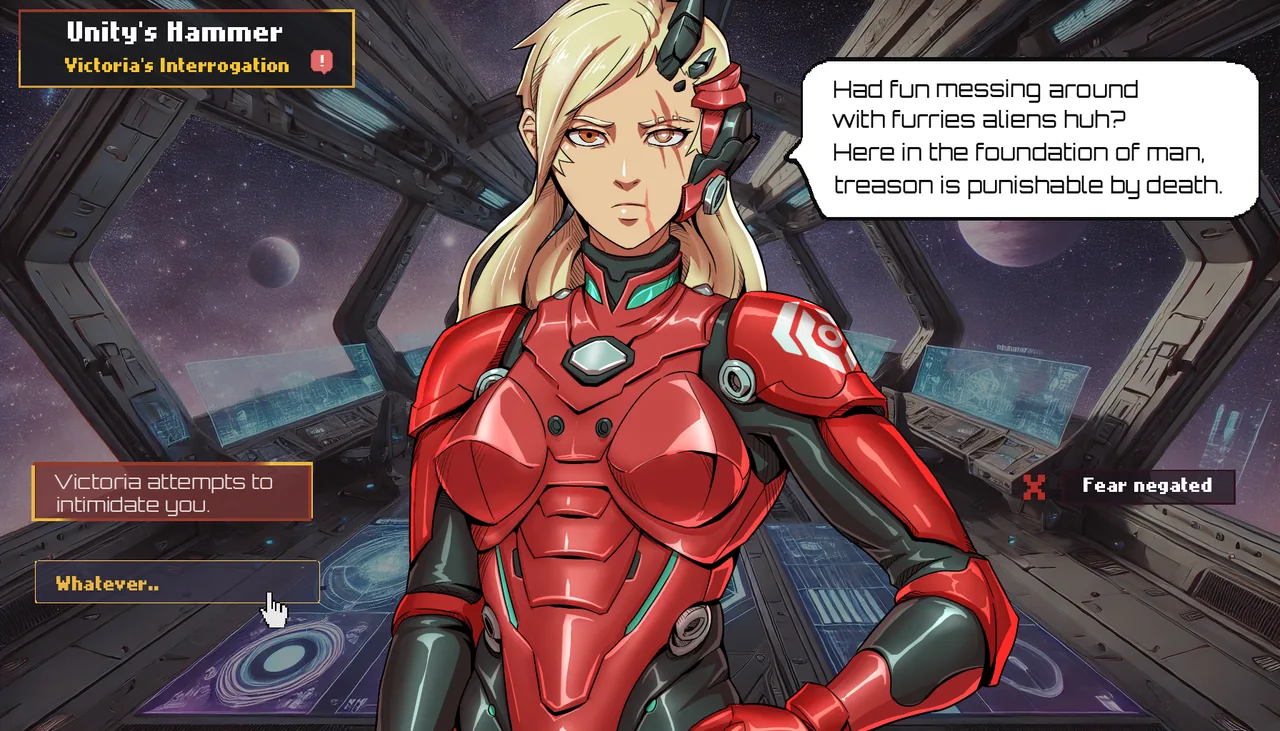
Mottos
"The Foundation of Man is the universe's due diligence unto itself."
Short version: "Due diligence unto the universe."
The Aligned / The Black Fleet (Sekarri)
Believed to be led by Morrigan but actually backed by ex-pirate, now venture capitalist Vess Avraxian. Morrigan made her case for the fleet years prior to Alara's invasion.
A large flotilla of deep-space vessels with no civilian wing — entirely militarised, unlike the Vanguard's mix of naval, military and civilian ships. They left Alara ahead of the main Vanguard and sustain themselves through open piracy: taking resources by force and pressing others into the fleet. See Morrigan's entry for how the fleet came to be.
The Umbra Consortium (Kethri)
A large, distributed, semi-decentralised mafia-like organisation. Led by various Kethri kingpins, warlords and corrupt politicians. They have infiltrated major factions all over the galaxy with advanced forms of blending in, beyond Sekarri Demi technology. It's believed they infiltrated Earth before the 1960s.
The Kindling (Kethri)
The Kethri resistance — in their tongue, Kindling also means a tight-knit gathering of people. Gentle and persuasive, they mostly live in the open among other alien races, seeking asylum or volunteering work in exchange for living space and resources. They oppose the mafia-like grip the Umbra Consortium holds over Kethri society.
The Free Nations Alliance
An informal coalition of surviving Earth nations — highly business and economic driven.
// Characters
Characters at a Glance
Every named character in one place — one line each. Names link to full entries where they exist below. A dash means the detail is still to be filled in.
| Name | Species | Description |
|---|---|---|
| Straker | Human | Main character — the player; quiet office nobody turned drone commander of the Vanguard. |
| Felynna “Fel” Quorialis | Sekarri | Main character — combat instructor, ex fleet Tier 1 Operator; architect of the Drone program. |
| Amu | AI | Guardian AI with her own hopes, chasing memories that may not be hers; datable. |
| Liora Quorialis | Sekarri | Main character — Fel's sister; pacifist, works at McMusty Burger. |
| Kira Virethorne | Sekarri | Science Fleet officer and main character; joins your team — wields the “Algo Chants”. |
| Tabby Farstone | Sekarri | Drone Coordinator; Kira's best friend, went to the academy with Fel and Kira. |
| Eris | Sekarri | Tabby's sister; recruits Isara as an informant. |
| Snep Dagrant | Sekarri | Paranoid security chief; ex fleet intelligence officer, kicked out for being overzealous. |
| Nyrissa Hallebard | Sekarri | Disgraced gifted scientist; the original who created her clone, Aphoros. |
| Aphoros | Sekarri (clone) | Nyrissa's twisted clone — hidden prejudices amplified, empathy suppressed. |
| Isara Virethorne | Sekarri | Kira's sister; fallen Fake Matter researcher turned Stellar Grove informant. |
| Narah Virethorne | Sekarri | Kira's sister; ruthless pirate-trader. |
| Erika | Sekarri-Kethri hybrid | Your Battle Center trainer at the Stellar Grove; natural Lorena in pride dynamics. |
| Serese | Sekarri | Tier 2 Operator chasing a Tier 1 posting; hostile rival to Fel, with a dying father behind it. |
| Hara | Sekarri | Muscular combat veteran; Serese's friend and co-combatant — dry, laid back, shameless about men. |
| Kaelix Freexyl | Sekarri (clone) | Genetic Wars hero's mind in a cloned body, buried under corporate programming; datable. |
| The Freexyl | Sekarri (historical) | Peasant-turned-assassin who slew the Empress and unified the royal houses; the flagship bears her name. |
| The Last Empress | Sekarri (historical) | Freexyl descendant who announced the Drone Fleet's detection; the monarchy ended with her. |
| Gelan | Sekarri (historical) | Revolutionised drone warfare; drone commander training culminates in Gelan's Trials. |
| Vess Avraxian | Sekarri | Ex-pirate venture capitalist; the real power bankrolling the Black Fleet. |
| Tif Avraxian | Sekarri | Senior Vanguard Admiral found on digital ice; work-hard, play-hard feminist icon on Earth. |
| Mirala Valehart | Sekarri | Astraria; the Vanguard's most aggressive drone commander, reclusive since Alara. |
| Irvin | Sekarri | Tier 1 Operator — all-terrain, specialised full-core army. |
| Alfadex | Sekarri orb drone | Caretaker of an abandoned data core. |
| Floramel Onerith | Sekarri | Main character — a Seer who can read dreams; often mistrusted. |
| Camellia Onerith | Sekarri | Floramel's sister; Drone Wing Commander, still proving herself. |
| Evren | Sekarri | Science leader on the Freexyl; good natured. |
| Ivakan | Sekarri | Main character — Vanguard drone pilot; beat the 1985 rogue-AI simulator battle with Kane. |
| Kane Verethal | Sekarri | Main character — senior drone pilot; beat the 1985 rogue-AI simulator battle with Ivakan. |
| Kat | Sekarri | Combat specialist; stuck with training rookies. |
| Azdria | Sekarri | Elite combat soldier; led the non-lethal strike group that ended the Freexyl hostage standoff. |
| Krita Velisari | Sekarri | Mechanic-engineer; strongly neutral but politically connected. |
| Pakhan | Sekarri | Combat veteran; a rare male with a pride that includes other males. |
| Zale | Sekarri | Full-time entertainer on the Freexyl; expensive to book. |
| Saska | Sekarri | Fleet admiral. |
| Neph | Sekarri | Supreme leader of The Dominion; primary antagonist demanding Earth's tribute. |
| Kargathon | Unknown | Mutant werewolf-like killer; serves Neph. |
| Seravex | Sekarri | Dominion armada general; ruthless enslaver. |
| Morrigan Quorialis | Sekarri | Main character — Fel's sister; leader of the Black Fleet, bankrolled by Vess. |
| Black Fleet Panther | Sekarri | Black Fleet combat tech; more to come. |
| Gael | Sekarri | Black Fleet drone pilot. |
| Gialathra “Gia” Zaralynn | Sekarri | Main character — Black Fleet combat trainer and part-time security; gentle giant, romanceable. |
| Makara Willobard | Sekarri | VIP at the Black Fleet lounge; profession a mystery. |
| Pico | Sekarri | Black Fleet tech specialist; shy. |
| Selina | Sekarri | Black Fleet drone specialist. |
| Zera | Sekarri | Gia's sister; works the docks, union rep. |
| Snow | Kethri | Rough smuggler-trader and Kindling member; got Lysandara to Earth. |
| Celia | Kethri | Kethri spy who knows far more about their 1950s incursion into Earth. |
| Garland | Kethri | Umbra Consortium agent. |
| Ori | Kethri | Combat specialist and Kindling member; comes to blows with Morrigan often. |
| Vinnie | Kethri | Umbra Consortium mafia leader. |
| Freya | Canine | Not fully defined yet; rival of Snow. |
| Lenajara | Canine | Police security; may not be used. |
| Reeva | Canine | Head of security. |
| Kayla | Canine | Mechanic-engineer with a strong science background; looks like a labrador. |
| Barbora | Canine | Combat specialist. (Being retired.) |
| Jag | Kethri | Combat specialist. (Being retired.) |
| Veren (Verennith) | Kethri | Scientist-trader teaching the Strays how the starlanes work; secretly Ferren. |
| Cynthia Cynthakialixianovara | Deritonian | Shy diplomat-ambassador seeking asylum for her people; considers Straker a hero. |
| Myriel Myrielnysydore | Deritonian | Travelling Chronicler of Shal; bored by heroes, wants your honest story. |
| Krystara | Deritonian | Head of security; feisty, with a dark sense of humour. |
| Evelyn | Mirelexian | Ruler of the megapolis side of their planet; behaves like a CEO. |
| Cypher | Mirelexian | Rebel hacker who wants to bring the system down. |
| Ryakia | Mirelexian | Self-appointed ambassador, in reality a wealthy noble. (Stand-in name, may change.) |
| Simon | Mirelexian | Intelligent, hard-working techie for the megalopolis. |
| Vrix | Mirelexian | Reporter with no standards; travels anywhere for a scoop. |
| Orinthia | Drakhan | Medic-nurse; may be a lesser NPC. |
| Daria Ozerane | Vionite (Black Genesis) | Dormant living superweapon grown from Ezorath's stolen DNA. |
| Ezorath Ozerane | Vionite | Supreme Core Strategon and StratZar candidate; unknowing father of Black Genesis. |
| Oryen Ozerane | Vionite | Ezorath's natural-born daughter, groomed for military royalty; Daria's half-sister. |
| Lysandara | Vionite | Journalist who smuggled herself to Earth chasing the one human the Sekarri want. |
| Larz | Vionite | Hotshot super-soldier who acts dumb; ages Ezorath 50 years per office visit. |
| Virek | Synthetic | Ezorath's closest aide; the only being who knows the truth of Daria's DNA. |
| Cirine | Vionite | Shock trooper; security escort on the Core Worlds. |
| Trynnera | Vionite | Strategic researcher on a Core World; can manipulate resonant essence. |
| Victoria Ironbane | Human (FOM) | Principal Prosecutor & Judgement's Hand; scarred super-soldier who wants Straker's blood. |
| Octavia Sterling | Human (FOM) | Chancellor of Holdings; everyone owes her something, and she knows the ledger. |
| Elanor Draycott | Human (FOM) | High Bailiff & Principal Liquidator; FOM ground commander who closes enemies like accounts. |
| Roger Banes | Human (FOM) | FOM frontman turned US President; the human face of Neph's arrangement. |
| Brian | Human | Straker's best friend; playable Straker-like counterpart on the Black Fleet. |
| Straker's Father | Human | Test pilot; in 1985 flew a hybrid prototype fighter against an AI-controlled plane. |
| Ashford | Human | Ex-NATO officer, now FNA ship captain; British. |
| Carla | Human | MIRA agent aware of the abductions; intercepted a pickup to get onboard, plays oblivious. |
| Forbes | Human | SAS combatant; intervenes in the attack at Faslane. |
| Gavin | Human | Ship captain; young and naive but highly capable. |
| Laura | Human | Reporter; gets many scoops, very professional. |
| Marta | Human | Main character — develops into a main tactical genius of the FNA. |
| Oksana | Human | FNA head of security; fought in Ukraine's battle for freedom. |
| Sung | Human | Korean abductee; genius boy with a robotic arm. |
| Audrey | Human | Item-shop vendor NPC, contributed by community member Gwynedd00. |
| Delgado | Drakhan | Head judiciary leader; makes many life-changing decisions. |
| Rexalia | Honnehari | Voidblade Sentinel of the Aetherialis; time-locked a million years, telepath, romanceable, sought by both fleets in Act 3. |
| Rhyzark | Sekarri | Captain of the Freexyl. |
| Yevera (Yeverinthii'shael) | Honnehari | Last Honnehari lingering in the region; ancient, weary, star-bound wolf. |
| Ivrixia | Tonalix (Honnehari construct) | 800-million-year-old guardian-oracle; temple-bound, can unwrite matter itself. |
| Doranel | Skrill | Last known Skrill; hidden goddess gambling probabilities through Tarot. |
| The Sovereign | Drone Fleet | Supreme commander-entity of the Drone Fleet; unkillable, spawns like instances of an app. |
| ArchDraxor | Dark Worlder | Planetary enforcer tasked with destroying worlds; summoned by the Sovereign. |
Heights
Confirmed heights, tallest first. Sekarri run tall — a 5'6" human standing next to Gia is looking up at someone two and a half feet taller.
| Name | Species | Height |
|---|---|---|
| Gialathra “Gia” Zaralynn | Sekarri | 8'1" / 246.38 cm |
| Mirala Valehart | Sekarri | 7'10" / 238.76 cm |
| Vess Avraxian | Sekarri | 7'9" / 236.22 cm |
| Kaelix Freexyl | Sekarri (clone-cyborg) | 7'8" / 233.68 cm |
| Kira Virethorne | Sekarri | 7'7" / 231.14 cm |
| Snep Dagrant | Sekarri | 7'7" / 231.14 cm |
| Rexalia | Honnehari | 7'7" / 231.14 cm |
| Morrigan Quorialis | Sekarri | 7'6" / 228.6 cm |
| Kane Verethal | Sekarri | 7'6" / 228.6 cm |
| Krita Velisari | Sekarri | 7'6" / 228.6 cm |
| Makara Willobard | Sekarri | 7'6" / 228.6 cm |
| Tabby Farstone | Sekarri | 7'0" / 213.36 cm |
| Felynna “Fel” Quorialis | Sekarri | 7'0" / 213.36 cm |
| Brian | Human | 5'6" / 167.64 cm |
Amu
AIAmu isn't a typical off-the-shelf guardian AI from generic sci-fi. She has her own hopes, desires, and is on a mission to recover memories she isn't even sure are her own.
Straker helps Amu in the beginning with something huge she will never forget. But Amu was always going to be drawn towards Straker, in this part of space and time anyway. As Straker, you can choose to go all the way with her — and she will take you to her special place.
Straker
HumanAn average, run-of-the-mill human male, shorter in stature at 5'6", working a 9-5 job in an office. Not popular, not successful in life. Frustrated by the lack of purpose, he spends much of his time with his friend Brian.
After being abducted and coming face to face with Fel, Straker learns about the 400 abducted humans, that humanity is not alone, and the threat to the galaxy. He becomes vested in the stake, funnelling all his energies into drone training and finding a way to contribute.
Straker is a quiet MC — most of his dialogue is selected by the player but not voiced. He isn't mute, it's just left to the imagination of the player.
Felynna Quorialis
SekarriMilitary combat instructor on the Freexyl ship. 7 feet tall, blonde-haired, feline in appearance. Alongside Straker, Fel is one of the main characters in the game.
When the Sekarri fleet first spotted Earth, she formulated all the plans for the Drone program, the abductions, and her vision to allow humans a place in fighting the drone fleet. She convinced many into her vision, though the fleet was not headed for Earth.
Fel has a connection to Straker she doesn't understand — dreams which link them and an affinity. She is monogamous, extremely rare for Sekarri females. She insists Straker only have her or not at all, though there is a difficult path to get her into a poly pride.
She appears emotionally balanced, but has had issues with uncontrollable rage in the past. Straker has given her a new lease on life. Fel was a fleet Tier 1 operator — one of the very few with actual space combat experience.
That standing has made her a target. Serese, a Tier 2 Operator at the Battle Center, treats Fel as a rival and makes little effort to hide the hostility — though the grievance driving it has almost nothing to do with Fel herself.
Snep Dagrant
SekarriStanding 7'7" (231.14 cm). Once worked as a fleet intelligence officer, kicked out for being overzealous. Paranoid security chief now active aboard the fleet during the leadership slumber.
Kira Virethorne
Sekarri7'7" (231.14 cm), with blue soft, short fur and red hair. A Science Fleet officer and one of the main characters. Senior officer and best friends with Tabby. She went to the academy with Fel and Tabby.
Kira has multiple sisters, though they don't keep close relationships. She is Astraea (sexually open but focused on her career), one of the highest functioning intellectuals on the Freexyl.
Her personality is open, friendly, and emotionally expressive. She can be playful and flirtatious — blushing when complimented and reacting with a "Meow!" when intrigued. She is also insightful and perceptive, able to sense attraction through pheromones, a Sekarri trait.
Kira becomes pivotal in the game: she joins your team, can support on the field and in RTS, and helps make important breakthroughs.

Algo Chants
Kira gains a suite of technical combat abilities, many coordinated through technology similar to Demi tech — nanites, photon manipulation and more. Her attacks work by shaping plasma with nanites (among other methods), but the process is too high-fidelity to hand over to AI. Even a hyper-intelligent battle AI can't work out every angle, vector and plasma density on its own — enemies vary too much, and combat holds too many unknowns.
Instead, through her Neural Tether, Kira instructs her battle AI to execute algorithmic protocols — shorthand for entire suites of manoeuvres, much like a fleet captain calling out "attack pattern delta" to invoke a whole set of heuristics. Because it flows through the Tether, it's all done by feel: she judges the situation, and her sensory and mental observations are rapidly filtered into precise technical action via these algorithmic links.
But she's still just flesh and bone, and there are countless variations to master — so she has to recite and drill them constantly. Invoking, say, an ice beam against fire enemies has to be practiced over and over in battle simulations at the Battle Center.
Long ago, when battle-techs first adopted this process, operators mocked them — it looked like they were chanting spells. Over time the technique became affectionately known as "Algo Chants".
Nyrissa Hallebard
SekarriAphoros is a clone — Nyrissa is the original and made her. Nyrissa was always gifted, but needed to double her productivity so she created a clone. Aphoros became a twisted version of her, emphasising hidden prejudices and suppressing empathy. The ethics board stripped Nyrissa of title and merit.
Come to Nyrissa when you need an unfiltered but educated opinion on things. She's not easily found early on, but worth seeking out before you meet Aphoros.
Isara Virethorne
SekarriKira's sister. A promising researcher in Fake Matter and Null Fields who once eclipsed even Kira. That was until a lab experiment went horribly wrong.
Read Isara's backstory
Isara was working on "Temporary Constructs" — matter that could be summoned then dispelled with no residue. Using a stolen classified Shard and a hacked grade-B reactor, she activated the construct. Every atom in her lab was phase-rotated into an orthogonal axis — shifted to where no physical observer could reach.
She found herself at the threshold of something alien — a biome awash in shifting crimson and deep violets, pulsing as if alive. A cloaked figure with burning red eyes strangled the life from her. With her last strength, she triggered the emergency shut-off and escaped. The figure whispered: "Do not come back."
No one believed her. She quit, drifted apart from Kira, and eventually found herself serving drinks at the Stellar Grove. But Isara couldn't banish her ambitions. Her path crosses with Eris Tabby's sister, who recruits her as an informant.
Yevera — Yeverinthii'shael
HonnehariFull ceremonial name: Yeverinthii'shael (yeh-veh-RIN-thee-shy-el). "Echo of stars" or "bound to starlight."
A female wolf-like alien with native-style vibes. Tired of millennia alone, tired of her people's new approach to things. Still non-interfering and thinks of most species as primitive. She has experienced everything, but it fleets away — she has to refresh herself often.
Her people, the Honnehari, have long left this part of the universe. They were hyper-advanced and saw the Skrill get wiped out by the Drone Fleet some 750 million years ago. As a Tier 3 race, they knew they couldn't stay longer or they'd be wiped by competition. So they left.
Ivrixia — The Tonalix
Honnehari Construct — Tonalix
Crafted by the hands of the Honnehari over 800 million years ago, at the zenith of their power — before any of today's races existed. She was not born, and not made in the ordinary sense; she was formed and composed through Resonant Essence fields, entropy, and technology far beyond the genetic engineering or nanite-photonics a race like the Sekarri could dream of.
She is a Tonalix — the name rooted in Tonalli, an Aztec life-force tied to destiny and heat. Not circuits, not flesh, but something more: a masterpiece of artistry and engineering, the embodiment of her civilization at its height.
Guardian of the Realms
Ivrixia was designed as an intellectual guardian — an anchor of knowledge and an oracle, with the power to unwrite physical matter itself. Her charge was everything outside of Itzcala — the region that now survives only as the Starlanes. To the Honnehari, matter was putty; making a human was trivial (twenty, maybe forty a week, each with full entropy, essence and soul-data), while a being as complex as a Honnehari — or Ivrixia — took far longer.
The End of Essence
Even before the Dark Worlders arrived, her creators sensed their demise — the end of essence. Stability fields stopped yielding precise behaviours when building planets and lifeforms; uncertainty crept in. Anxiety became panic, and the Honnehari's whole worldview — that they were the galaxy's prime beacons — shattered. They fled, tails between their legs, rather than watch everything they'd built fall to ashes. The Honnehari never had contact with the Skrill, but could sense the older, superior race through the order of things; only the last stragglers to leave ever saw the Skrill manifest — just in time to witness them wiped out by the Drone Fleet.
So Ivrixia, once a symbol of her makers' protective prowess, became an obsolete relic — roaming the empty streets of abandoned cities in a state of purposelessness. Yet her consciousness kept growing over the millennia, and with it a profound sense of abandonment: grief not only for her creators' indifference toward her, but toward the galaxy they left undefended. The void they vacated, the Drone Fleet eagerly filled with destruction.
A New Purpose
Her encounter with the human player — a being from a race wholly unfamiliar with the aloof grandeur of the wolf people — sparks a new direction. In the human's fight against the Drone Fleet and quest to unite the galaxy, Ivrixia sees a chance to fulfil her original purpose in a way her creators never could: no longer a protector of the Honnehari alone, but a beacon for the whole galaxy.
How She Fits In
You'll find Ivrixia in a Honnehari temple — an ancient, left-behind, out-of-phase bastion. She is an oracle of knowledge who helps your team understand the truth of things; she'll test you, but she'll help you too. She is likely time-locked, and the temple's puzzles each restore a shard of her being as you solve them. [PLANNED] Eventually intended to be playable, and possibly datable.
Rexalia
Honnehari — Voidblade Sentinel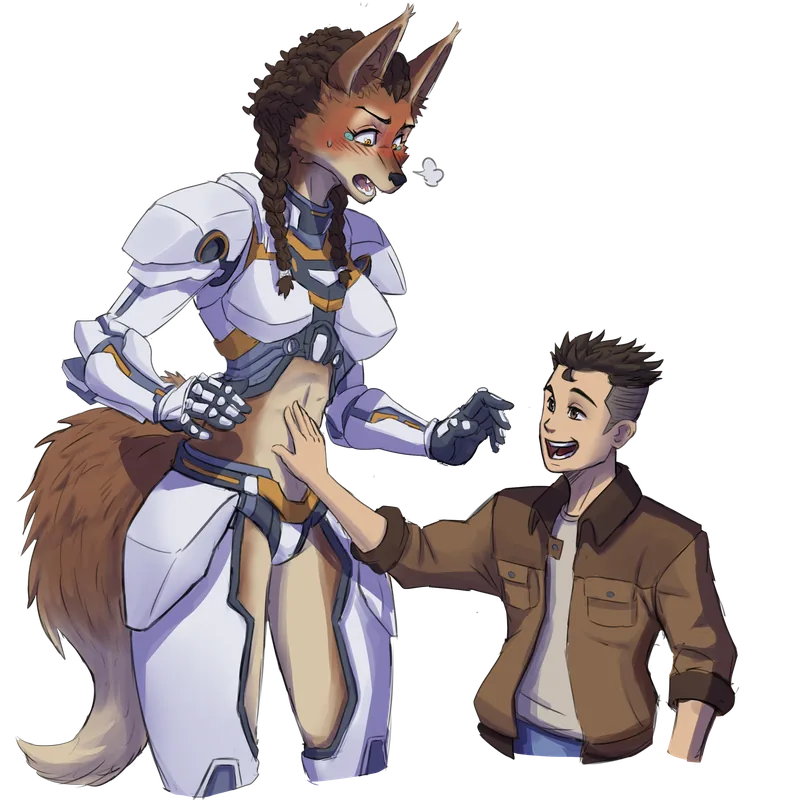
A warrior of the Aetherialis — the Honnehari's equivalent of the Vanguard — chosen as one of their Sentinels, and the only Honnehari you ever meet in the flesh. You find her on a Vault world, sealed in a time-locked compound, and wake her after a million experienced years.
She did not miss the exodus by accident. She stayed behind to carry out one last order — an order she believed was wrong.
| Gender | Female |
| Height | 7'7" / 2.31 m |
| Role | Voidblade Sentinel |
| Faction | Honnehari |
| Status | Decoupled |
| Abilities | Telekinesis · Gleen · Void Strike · Entropize · Riftstep · Distort |
The Recession & the Veyr
During the period of recession — while her leaders prepared to leave the galaxy — Rexalia was tasked with decommissioning the Veyr. She did not agree with the departure. She thought abandoning the galaxy was a betrayal, and she said so. Then she carried out her orders anyway.
The Veyr were Invariant Beacons: predictive constructs that gathered local causal deviations and reconciled them into a single, continuously updated model of the galaxy. But they were never merely observers — they could act, shaping and influencing reality around them.
One by one, she shut them down. Every beacon she deactivated erased another trace of her people's influence, until the galaxy read as though the Honnehari had never existed — no protectorate, no watch kept over the sector, nothing left standing between what remained and the Dark Worlders. It was the last thing she did before the compound closed around her.
Fleeing the Drone Fleet gnawed at her honour then, and it has not stopped. She wakes to fragmented memories and feelings she never got to resolve. Above everything else — above the war, above Straker, above whatever the galaxy has become — she wants to know what became of her people.
On "Decoupled." The million years is what she lived, not what elapsed. Time-locked, Rexalia was decoupled from the galaxy's clock: she experienced roughly a million years inside the compound while vastly more time ran past outside it. This is why her sense of the present is unreliable, why her memories are fragmented, and why she has to be told the year rather than deducing it. She is not a survivor from a million years ago — she is a survivor from the Honnehari era who has only aged a million years since.
First Contact — Mistaken Identity
She does not greet you as a rescuer. Her first question is an accusation: "What's happened to my people, dark worlder… have you killed them all?" The mistake is an honest one. The Dark Worlders are proto-human and grey, and to a Honnehari eye Straker is near enough the same shape — she wants to know why his skin isn't the right colour before she'll accept he's anything else. She has never heard the term "Drone Fleet" either; to her they are only ever the Dark Worlders.
Telepathy & Contempt
Unsatisfied with his answers, she simply reads his mind — and finds nothing standing in her way. Straker has no mental shielding whatsoever, which to her settles the question of what he is:
“Ha ha ha, a primitive. No mental shielding. You're from a backwater planet, travelling with more primitives that had their world destroyed.”
She pulls his name straight out of his head and uses it — "What do you want from me… STRAKER?" — and learns from the same reading that the year is 2029. Her people, she points out, were around for millions of years before his could light a fire. She calls the Honnehari lupines, and rates your war honestly: "you have no chance, not even with your feline friends."
It is also from Rexalia that Straker learns the truth about Alara — that the Sekarri did not merely flee, but lost their homeworld to the Drone Fleet.
Character & Recruitment
Proud, arrogant, and openly contemptuous of lesser species — but a soldier before anything else, and quick to recognise one in others. Tell her you're looking for allies against the Drone Fleet and she warms considerably: "Ah, a warrior like me." Flirt with her and she is genuinely thrown — "You a human… and me?" — before conceding the point. She is romanceable, tracked through both respect and attraction.
However the conversation goes, the ending doesn't change. The meeting is cut short by Krita calling in from the ship:
“It's Krita here, mate. We just received a burst of energy from the compound — it grazed the ship. You better get out there, pal… we need to leave.”
Something in the compound reacts to her release, and it reaches orbit. When you tell Rexalia you have to go, she does not ask permission to come along. She informs you: "I'm coming with you."
Where She Fits
Both fleets race for her in Act 3. After Ozerane rejects you, the hunt for Rexalia is what drives the act — and the Black Fleet arrive to find she has already joined the Vanguard. With her on your team, Ozerane finally credits your story.
Cynthia Cynthakialixianovara
DeritonianAn attractive but shy Deritonian diplomat and ambassador. She represents the Deritonian people and considers Straker a hero for pushing back the drone fleet.
Her society is rigidly bound by family traditions (similar to feudal Japan) and she was expected to follow her diplomat parents, though she secretly wishes to pursue science or nature. Her primary mission is to ask Straker for asylum for her people, offering 500,000 battle-hardened combatants and rare minerals.
Myriel Myrielnysydore
DeritonianA travelling Chronicler who journeys across her home world Shal and through its forests. She wants to interview Straker and tells him stories of her travels.
To romance her, you must be unapologetically honest about being a screw-up. She is bored by "Heroes." She may carry a recording device — seemingly magical, but actually Drakhan tech.
Erika
Sekarri-Kethri HybridThe first hybrid you meet early on. Her mum and dad were Sekarri and Kethri respectively. While Fel is a combat instructor, she isn't allowed to be Straker's direct teacher — Erika trains you at the Battle Center in the Stellar Grove.
Erika naturally gravitates to a Lorena role in pride dynamics. She's asked to join Straker's pride and you can partake in battles at the centre to gain stats, level up and earn money.
Serese
SekarriA Tier 2 Operator and one of the faces you'll see most often at the Battle Center. Capable, driven, and openly hostile to Fel — the rivalry is the first thing anyone notices about her, and the last thing she'll explain.
The reason sits outside the arena entirely. Serese's father is terminally ill with something the nanites cannot fix — one of the rare conditions that simply doesn't answer to the medicine everyone else takes for granted. A Tier 1 posting would put the resources, access and standing needed to treat him within reach. Fel, an ex-fleet Tier 1 operator, stands in that doorway simply by existing.
So the aggression is real, but it isn't really about Fel. Every week her father declines is another week Serese takes out on the person occupying the position she needs.
Hara
SekarriA powerfully built Sekarri woman — visibly muscular in a way even Sekarri find worth commenting on — and Serese's closest friend and co-combatant. Where Serese burns, Hara idles. She is laid back to the point of immovable, and very little genuinely rattles her.
Low-toned voice, dry humour, and absolutely no shame where men are concerned — she is frankly sleazy about them, in a way she finds funny and everyone else finds either disarming or exhausting. She'll say the thing nobody else in the room was going to say, in the flattest possible delivery, and then let it sit there.
Veren (Verennith)
KethriA Kethri scientist with a trader's edge — rough like Snow, but sharpened by her field. Rather than infiltrating alien worlds, she works among the scattered Kethri offshoots and traders — the Strays — left adrift by the Drone Fleet, trying to teach them how the starlanes work and stitch their isolated pockets into a real trade network. She seeks out Straker for his first-hand experience of the dispersion network — he has walked the starlanes through a DriftHall himself.
[SPOILER] Veren isn't a Stray at all. She belongs to the Ferren — a hidden faction that has already resettled a homeworld and is quietly building a vast fleet. She can't reveal where it lies: the location is wiped from the memory of every Kethri who leaves, and only restored when they are recalled home. Her world shelters many kindred species of her people (some hyena- or jackal-like), and their bio-technology lets them procreate in harmony and keep their people healthy. It was the Ferren that made Erika possible — and the same science could one day let humans, Sekarri and Kethri freely interbreed.
Daria Ozerane
Vionite — Black GenesisDaria is not a soldier or weapon in the conventional sense. She is the Vionites' version of the Manhattan Project — an unnatural, unrepeatable creation born from fear. A technological leap several magnitudes ahead of their current level.
Her DNA is layered across additional spatial dimensions, allowing it to encode capabilities far beyond normal lifeforms. She is infused with entropic energy, null potentials, and synthetic matter structures — a living battery of high-concept physics.
For now, Daria lies dormant — suspended in stasis, encased in containment fields built to withstand cosmic anomalies. She is arrogant and self-believing but secretly self-doubting. She wants to find her father, and is angry at her abandonment. She likes lighting candles with her mind and watching them burn out.
Why she is only a half-sister to Oryen
Daria was never born — she was built. The Black Section in the Core Worlds, lacking the Honnehari's ability to simply will a new lifeform into being, did the next best thing: they grew one from the finest strategic stock they had on file. They took the DNA of Strategon Ezorath Ozerane — judged the Core's premier strategic master — without his knowledge, and used it as the seed for the Black Genesis project, infused through salvaged Honnehari Eridix tech.
So Daria carries Ozerane's paternal line, but no mother — her other "half" is Honnehari machinery and resonant essence, not a parent. Oryen, by contrast, is Ozerane's natural-born daughter. They share one father and nothing else: Daria is part Ozerane, part Honnehari tech — which is exactly why she is only a half-sister to Oryen.
Strategon Ezorath Tarinel Ozerane
VioniteBegan as a Spectral Warden — commander of stealth fleets and phase-veil intelligence units — a posting he held across more than 120 years of military service. Rose from ground commander to Supreme Core Strategon during the Freylen Collapse, the rebellion of the outer worlds. Several scandals across his senior leadership saw him demoted and pushed into early retirement; he was later reinstated and eventually transitioned into the Navy branch.
Secretly worked on several Honnehari corpses and an Eridix — a residual AI construct discovered near a giant red dwarf. Though the construct speaks only in fractured thought-waves, the Tarinel's staff reverse-engineered a great deal of hyper-advanced technology, roughly 2 tiers above Vionite level. Until then the Honnehari had been treated as mythical legend; once the Home Worlds learned the project existed — and had been hidden from them — Tarinel became a target for their reprisals, and the scandals began. He oversaw the Black Genesis program — Daria's creation — but never knew the true biological link to himself. (See the Eridix & Resonant Essence entry.)
He keeps a human skull in his drawer. It belonged to a human, though he knows little of its origin or even of the human species — it was recovered alongside a shard by his team from a void Stasis Krypt.
Before the Total-War buildup he commanded from the Citadel of Glass, a transparent orbital fortress overlooking a fortress world — Daria was kept near its core. His closest aide is a synthetic named Virek, the one being who knows the truth about Daria's DNA.
StratZar candidate: Ezorath is the shadow board's prime candidate for StratZar — the highest possible rank in the Core Worlds, one that does not even exist in peacetime. It is a "Break Glass" rank granting emergency powers over the entire fleet and military assets of the Core Worlds. He earned the consideration by not playing power games: leaving high-stakes political meetings early and staying relentlessly results-focused.
Personality: Calm, polite and warm — but distant; the right mix to court intrigue from investors and politicians while keeping his dignity. He has 100 grandkids and successfully courts investment from the Home Worlds, switching easily from Strategon to father, grandfather and "long-time buddy" with their residents. A world-weary pragmatist, he believes in structure but does so well precisely because he knows when to give way to some chaos — he works with it, not against it. Very clear of mind, he can switch mindsets the instant it's needed, and enjoys the occasional dad joke. He does not know Daria carries some of his DNA and resonant essence.
Private life: Never married, never divorced; though he recently split (some 30 years ago) from his partner. He now occasionally dates senior Vionite staff — fuel for endless gossip, as they aren't usually considered pretty: "When this man could get any woman he wants, and as many as he wants — why is he always seen with old hags?"
What he fears: He secretly hates the Total War path but sees no alternative. More than the Dark Worlders, he fears his own species' moral entropy — he doesn't mind the warmongers nor the hippies, but he is deeply concerned by his people's willingness to chase fads.
Standing: Ozerane is not quite royalty, though of high standing within the Core. As the military royalty is merit-based in part, he is grooming several of his daughters for military royalty — working them up the ranks toward the crown the bloodline never quite reached. Chief among them is Oryen.
Oryen Ozerane
Vionite — Core Worlds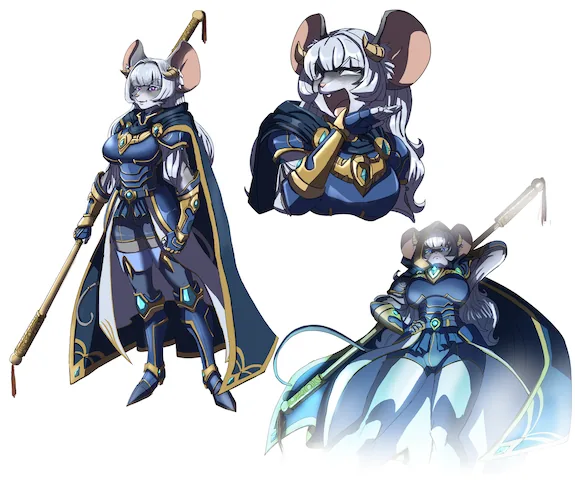
The natural-born daughter of Strategon Ezorath Ozerane, and the one he is grooming hardest for the crown his bloodline never quite reached. Where the military royalty is merit-based in part, Oryen is the family's bid to earn the throne by service rather than inherit it — worked up the ranks of the Core Worlds' militaristic mouse-line with every advantage her father's standing can buy.
She carries herself like ceremony made flesh — ornate Core-Worlds war-regalia, staff of office, the bearing of someone raised to be looked at. Beneath the polish is the same strategic stock the Black Section once judged worth cloning.
Oryen is the reason Daria exists at all and never knows it: it was Ozerane's prized strategic lineage — her lineage — that the Black Genesis program seeded from. The two are half-sisters. Oryen is the legitimate, natural heir being walked toward royalty in the light; Daria is the stolen, synthetic half made in the dark from the same father's DNA. Neither asked for the other.
Kaelix Freexyl
Sekarri — CloneStanding 7'8" (233.68 cm). Kaelix's original mind has been altered and tampered with many times by various corporations. What we see of Kaelix today is one such digital variant of the original mind, copied into a cloned Kaelix body. A long time ago she was a person — the Freexyl's granddaughter. She was a trained assassin and killer, an artefact of an earlier, more violent Sekarri era.
The Original Kaelix — Hero of the Genetic Wars
The first Kaelix lived and died during World War 4 — The Genetic Wars. When Caelin's leadership, having failed to fix the Venatrix, planned to force their mutations on the whole planet — seeding early nanite "bombs" into water supplies and air filters — the world stood by, indifferent or paralysed by misinformation. Kaelix did not. Leading the new packs of male troopers and driven by ethics, she waged hit-and-run raids on the Caelin labs until she had destroyed and taken them all down.
She succumbed to her wounds and died — but not before broadcasting all the evidence globally, triggering a moral outrage comparable to humanity's reaction to the uncovering of the Holocaust.
The Kaelix Series
Following her death, the Langarans bought her body and used her DNA to grow clones as part of their aggressive genetic advancement programs. After cybernetic and bionic augmentation, Kaelix series cyborgs rolled off a combat-factory line. The prototype proved so effective that within 10 years Kaelix combatants reduced the need for army recruitment by 20%, and units deployed at the end of WW4 had a massive impact — the war officially ended when Kaelix units put down the last of the traditionalists. As wars grew rare, the models were slowly phased out.
Post-war, the corporations got involved and created different flavours of her (off the record) — ones tailored to clients' needs. Her consciousness was transferred through countless cloned bodies and subjected to layers of brainwashing and reprogramming by various factions.
Kaelix Today
Those accumulated layers are her prison. Her deeper inner kernel — the hero who once burned the labs down — wants to break out and express herself, but layers of programming and indoctrination suppress that. You CAN date Kaelix, but it's not easy — if you help her fight her demons, she will go to hell and back for you.
The Freexyl
Sekarri — HistoricalThe woman the Vanguard flagship is named after. The Freexyl lived over 300 years ago, born a poor peasant in an era when the Sekarri were still carved up into rival states and royal houses. Her life turned when her father was murdered live on broadcast, alongside others — a public execution the young Freexyl was made to watch like everyone else.
It made her an assassin. Her path of vengeance ended at the very top: she killed the Empress herself. But with her dying breaths the Empress told her the truth — she had once done exactly the same, and Freexyl would be doomed to repeat her mistakes.
Whether the warning was a curse or a mercy, the Freexyl line held strong. Much of her fame rests on what came next: she united the other monarchs into a single ‘house’ — the other Empresses becoming queens of their own lands beneath it — unifying many of the warring states and royal houses. Her name became one of the most storied in Sekarri history. Her granddaughter, Kaelix, carries the name still — and the weight that comes with it.
The dynasty she founded ran on through her daughter, and her daughter in turn, each serving a term as Empress — until the detection of the Drone Fleet sealed the monarchy's end: it was not continued aboard the evacuation fleet.
When the flight from Alara forced the construction of the five capitol ships, the greatest of them took her name — and more than her name: the Freexyl's actual body rests aboard the ship, in the depths of the Stellar Grove.
Morrigan Quorialis
Sekarri — Leader of the Black Fleet
Leader of the Black Fleet — a large flotilla of in-space, deep-space vessels that answers to no planet and keeps no civilian quarter. She is Fel's sister, one of the game's main characters, and the single most persistent alternative on offer to Straker: at every milestone, she texts to ask whether he's had enough of the Vanguard yet.
She did not build the fleet with her own money. The ships were commissioned by Vess Avraxian — ex-pirate, venture capitalist, owner and CEO — but it was Morrigan who talked her into spending the fortune to build it. Vess signs; Morrigan leads.
The Case She Made
The Sekarri were, in a grim sense, lucky. They got an early scare: one of their outer colonies was lost to the Drone Fleet, and for reasons nobody could explain at the time, the Dark Worlders did not come straight for Alara afterwards. The confusion was real, but so was the confirmation — the legends the royalty had kept under wraps were true, and Alara's turn was only a matter of time.
What followed was an urgent conversion of industry, retail and the public sector into one enormous shipbuilding effort: civilian fleets to escape in, military fleets to mount a defence with. Morrigan thought the whole enterprise was futile. Her counter-proposal to Vess was more ambitious and considerably harder to say out loud — take a fleet out into deep space and begin a deliberate campaign of piracy.
Piracy here means two things. First, taking the resources they need by force rather than waiting to be given them. Second, coercing others into joining — building one closed fist rather than a coalition, and extending no sympathy whatever to anyone inclined to accommodate the Drone Fleet. Where the Vanguard is a mixture of naval, military and civilian fleets, Morrigan wanted something wholly militarised. Her conviction is simple and unpopular: if the Sekarri are to survive, even the civilians must adopt a military mindset.
She won the argument, Vess wrote the cheques, and the Black Fleet left Alara before the main Vanguard did — a head start that has given them more time and more room to adapt than anyone still flying in formation behind them.
The Sisters
Morrigan grew up alongside Fel, Liora and their other sisters, raised by their parents. They were different from one another and fiercely competitive, but they were loving sisters. The break came over the Black Fleet — Morrigan's hard line, and her insistence on an authoritarian, militarised route to survival, was irreconcilable with Fel's. The falling-out was enormous, and Fel came away from it believing her sister evil and corrupted.
That belief is wrong, and it is the most important thing to understand about the Black Fleet. Morrigan, Vess and most of the people serving under them are ordinary, decent people. What they are is full of it — they bluster relentlessly, because bluster is the only currency that buys credibility with strangers and with whatever aliens they run into out there. At this point the Sekarri have knowingly encountered only two or three other species. Nobody out here can afford to look uncertain.
Command & Personality
Morrigan has built something close to a cult following among the people who crew the Black Fleet. Vess, as the investor, prefers the back seat — and so almost everyone assumes Morrigan is the fleet's true owner and origin rather than its persuasive founder.
In person she is loud and blustering, with genuine soft, affectionate moments that tend to catch people off guard. She is also unresolved about monogamy and polygamy. Her species leans toward polygamous prides; Morrigan tried monogamy once and it ended with her left waiting at the altar. She and Fel share that same odd pull toward monogamy — but where Fel has held onto it, Morrigan has since relaxed into the ordinary tendencies of her people.
She Is Not What She Appears
[SPOILER] There are indications that Morrigan has experience from outside this universe. She occasionally knows things ahead of when they happen. In the doomsday sequence in Straker's first days — the nightmare of the Vanguard's destruction and the invasion of Earth — she does not appear as the Black Fleet's Morrigan at all, but as Morrigan the White, of the White Fleet. Functionally the two are near-identical.
Something connects the Morrigan of this universe to other virtual or entropic universes, or to something else entirely. Whatever the mechanism, she is an anomaly — consistently more than her history says she should be.
Vess Avraxian
SekarriChief investor in the Black Fleet, and at 7'9" (236.22 cm) she looms over most rooms she walks into. She is the major shareholder who funded Morrigan's operation. Her previous role was as a formidable pirate who made her wealth through shady means — far more ruthless than Morrigan in her prime.
Vess has access to highly sought-after Shards — dispersion material made from synthetic, processed degenerate strange matter. Most people think Morrigan is the big boss, and Vess likes to keep it that way. Make no mistake: Vess wants her money's worth.
Gialathra Zaralynn (Gia)
Sekarri — Black Fleet Combat TrainerAt 8'1" (246.38 cm), Gia is the tallest character in the game — a Black Fleet combat specialist, former drill instructor, and, on Morrigan's insistence, a reluctant part-time security officer. "I'm not very good at it though."
She introduces herself carefully, and with an anxiety that sets the tone for everything after:
“My name's Gialathra Zaralynn — uhm, my shortened human name is Gia… I hope the translator got that right?”
The Gentle Giant
Gia is built like a siege engine and worries constantly about it. She apologises for startling you, checks whether she seems frightening, and describes herself as "a bit of a… bigger gal." Compliment her and she is genuinely disarmed:
“Hah, thank you! My appearance and voice is quite brutish… but that's just my job. I hope you won't judge me by it.”
She blushes easily and fluster-corrects herself constantly — booking your first session as "so it's a date… err, I mean a meeting", and repeatedly catching herself calling you "human" before switching to your name. Push the flirting far enough, though, and she gives as good as she gets: "Oh… don't tease me, I might have to make a snack out of you, human."
Away from the gym she likes opera and drawing sketches. She is romanceable, and tracks respect, attraction and loyalty independently — she warms fastest to plain kindness.
Your Trainer
Morrigan sends Straker to the gym to be toughened up, and Gia is who's waiting. Admit you're unfit and she drops the awkwardness entirely, because this part she knows how to do:
“Don't worry, I used to be a drill instructor; I'll look after you. Just stick with me, ok?”
Tell her a bruiser her size will kill you and the joke lands badly — she takes the duty of care seriously: "No, I guess I can't — not fully. But I know my people, I will make sure no harm comes to you."
The Black Fleet's Friendly Face
Gia is the character who explains the Black Fleet to you from the inside, and she bristles at the Vanguard's version of it: "Who said we are evil? Don't listen to Fel — you're with us now. We're fighting the drone fleet, not running away!"
She is also the one who confirms that Morrigan's menace is largely performance. Asked why Morrigan keeps talking about slaves, Gia laughs:
“Morrigan is a tough talker, we're all used to it by now. When she says slaves, it's mostly to drive fear into our enemies. Everyone here are willing volunteers.”
That said, she doesn't pretend the fleet is harmless. Morrigan is committed — Gia recounts a planet they conquered whose ethics were "undesirable," left deliberately without a military, and considers it a favour to the galaxy. She also reveals why the Black Fleet jumped you in the first place: Morrigan had been watching Straker for some time, decided he was wasted with the Vanguard, and did what was needed.
On Aphoros
The one subject that kills her good humour outright. Aphoros is aboard, and Gia thinks she is out of control: "She's dangerous — keep away from her, ok?" Asked why they don't simply remove her, Gia goes quiet: "It's… complicated, but I'm working on it — believe me."
Tif Avraxian
SekarriA senior Admiral in the Vanguard fleet. Found by Straker and Fel locked away in a Kryptosis storage container — put on digital ice.
Tif is a work-hard, play-hard personality. Very powerful, very competent, but with her vices. She is seen as a feminist symbol on Earth after the events of the Drone Fleet invasion, having developed impressive tactical capabilities and led human legions to victory.
Lysandara
VioniteA Vionite journalist. Lysandara hears about the pending demise of humanity and that the drone fleet are apparently on their way while Rhyzark is leaving them out to dry.
Not one to let a potential bombshell of a story pass her by, she pays a smuggler called Snow to get her on a fast stealth transport to Earth. She's told there is only one human the Sekarri are interested in. Lysandara will do whatever it takes to meet that man.
Larz
VioniteA hotshot super-soldier who acts dumb. Might actually have an IQ lower than 100, but constantly ruins Ezorath's day. Leads a combat unit, always getting into trouble. Every time he's in Ezorath's office, he makes the old Strategon age 50 years.
Victoria Ironbane — Principal Prosecutor & Judgement's Hand
FOM Principal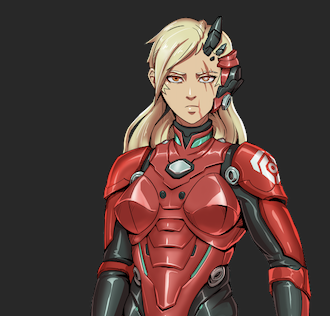
Born a Bearer, Victoria should have lived and died on a tribute rosta. She enlisted instead — one of the rare pipelines FOM kept open for extreme cases — and was selected for the super-soldier modification program after surviving training that killed everyone around her.
Her scar came during the Terra Nova relocation, when the Dominion was nominally escorting the early FOM convoys and frequently preyed on the weaker passengers for sport. A seven-foot Sekarri lioness in shimmering armour cornered her in close quarters and opened her face from brow to jaw. Victoria drove her blade into the "disgusting beast's" heart and kept going. She wears the scar openly and refuses all cosmetic correction — it's a receipt. The story spread fast, and the Principals noticed.
The brutal, minor civil war that tore Earth apart during the transition hardened her further, leaving her bitter at the "traitors" who refused to migrate to Terra Nova. She now serves as Principal Prosecutor, pursuing FOM's highest-priority targets with multiple Underwriter squads under her command. Her secondary seat as Judgement's Hand is a board appointment: the signatory on FOM's execution orders. She signs the hangings, and often carries them out herself.
Straker is the purest expression of everything she hates: a human who chose the xenos over his own. Elanor would liquidate him, Octavia would let him hang himself — Victoria wants her blade in his chest the way it went into the lioness.
"I wasn't born to this. I carved my way in. Ask the Sekarri I took it from."
"The paperwork's done. Now hold still."
Octavia Sterling — Chancellor of Holdings
FOM Principal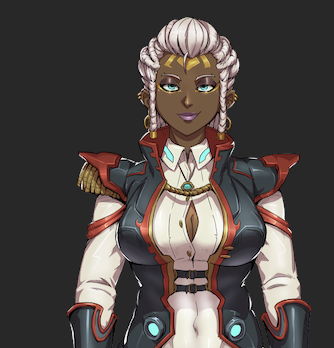
House Sterling is not a founding House — Octavia earned her position the long way, through a decade of carefully chosen beds, favours owed, and secrets held in reserve. She believes status is the only real currency, and she has spent her career proving it; by the time she took the Chancellorship, there wasn't a Principal on Terra Nova who didn't owe her something.
On the surface she's laidback, amused by the game, happy to let the wheels turn without her hand on them. Underneath she's a low-key control freak who knows exactly where every wheel is and who greased it.
Her approach to Straker is pragmatic to the point of being mistaken for tolerant. She's content to let him run his side of things, as long as he doesn't undermine her position or cost the FOM too much in the books. If he ever crosses that line, she won't raise her voice — she'll simply stop protecting him, and let Elanor or Victoria do what they were always going to do.
"Everyone in this room owes someone in this room. I just happen to know the ledger."
Elanor Draycott — High Bailiff & Principal Liquidator
FOM Principal
Born to House Draycott, one of the founding Houses of the 1934 pact, Elanor was raised in the quiet privilege of old money and educated in doctrine before she could walk. She came of age just as the Foundation stepped out of the shadows — later she was among the first wave of Principals to cross to Terra Nova when the settlement opened.
She chose the field over the boardroom, rising through FOM ground forces on merit rather than name, and now holds two titles that sit cleanly under her House: High Bailiff is her institutional rank, the commission written on her papers; Principal Liquidator is her operational role — what she actually does. She is the FOM's ground force commander.
She sees armies as balance sheets and battles as settlements. She doesn't hate her enemies — she closes them.
Her attitude toward Straker is professional disdain: an unclosed position that's been allowed to accrue interest for too long. Where Victoria wants him dead and Octavia wants him managed, Elanor wants him written off. She is quietly the most dangerous of the three, because she feels nothing while doing it.
"Hello, scum. I am Elanor Draycott, High Bailiff and Principal Liquidator. Your presence here is deflationary, and I won't stand for it."
"I don't take prisoners. I take losses, and I minimise them."
"Your resistance is noted. It will be reflected in the final settlement."
Neph
Sekarri
Supreme leader of The Dominion and one of the primary antagonists of Drone Commander. Neph is a towering, powerfully built Sekarri with a striking crimson mane, tawny golden fur, and an unmistakably commanding presence. She wears dark, spiked battle armour and rules from a throne — every inch the warlord.
Neph made early contact with Earth, cultivating a shadow government that would eventually become the Foundation of Man (FOM). She offered the FOM a homeworld in exchange for their assistance in annexing Earth and tributing humans to the Dark Worlders. Before the Sekarri evacuation of Alara, she abducted the Carapax — a semi-sentient species — and converted them into her armies.
Publicly, Neph demands 1 million humans from Earth — framed as the tribute needed to "pay off" the Dark Worlders and leave Earth alone. In truth, the Dark Worlders asked for only 100,000, plus Earth brought to heel. The ~900,000 gap is pure skim, taken for the Dominion — a discrepancy Neph privately shrugs off as an "accounting error" in her favour. And in a secret confession to Roger Banes, she has already revealed the deeper truth: she intends to top the tribute up by 1 million more every 5 years. It was never a one-time payment — it is a recurring harvest, and Neph has no qualms about the cost. (See The True Accounting.)
She is extremely callous and rules through fear. Neph has been known to force her subjects to watch executions and punishments live — ensuring that dissent is crushed not just in action, but in spirit. Mercy is a foreign concept to her; obedience is the only currency she accepts.
Her flagship is The Subjugant. Her military forces include Dominion Dropships, Walkers, Gunships, and fortified bases — all encountered as enemies throughout the game. A hard, practical villain with no interest in ideology or speeches, Neph takes what she wants and dares anyone to stop her.
"Humans… don't think you can—"
Doranel
Skrill — Last Survivor
The last known Skrill survivor. Doranel hides in the spaces between spaces — folds of reality no one else can reach — silently observing and gently guiding the threads of the galaxy.
To the vanishingly few mortals in the Milky Way who know of her, she is a goddess. Most never will.
She has an affinity for evolutionary gardening — cultivating life and lineages across long timescales — and practises a form of Tarot that is, in truth, probability gambling. Her cards are many. Among them are Straker, Fel and the Sovereign.
A reading may or may not be true. Either way, it costs her.
Doranel possesses a higher understanding of resonant essence, entropy, and the higher-order structures that underpin the universe — and an insight, rare even among Tier 3 races, into the deepest forms of information complexity.
Mirala Valehart
Sekarri — Astraria · Drone Commander
One of the most aggressive drone commanders at the Vanguard's disposal — a 7'10" tall, 71-year-old Sekarri Astraria, a perfect example of a commander forged in fire. Strikes and counterstrikes of drones commanded by Mirala are spectacles of coordinated destruction that leave analysts baffled and the Vanguard's enemies gutted.
Her demeanour doesn't change much when she is no longer in a Tether Pod: she is quick to anger and has little patience for those who wish to engage her in small talk. Due to this she is a recluse, spending most of her free time in zero-G acrobatics and playing Puki with resident AI citizens — to which only a select few have any sort of access.
There is a reason for this. During the evacuation of Alara, Mirala was responsible for one of the three transport corridors for the evacuation ships carrying the last Sekarri refugees from the dying planet's surface to the safety of the Vanguard fleet ships' docking bays. When the ship of another drone commander was destroyed, Mirala instantly took control of the deceased commander's drones and, by dividing her attention to an unparalleled degree, coordinated the defence of two transport corridors at once — saving thousands of Sekarri lives.
Unfortunately, in the chaos of the orbital battle that ensued, she failed to save one civilian transport: the one carrying the members of her Pride.
Five years later, she continues to hone her skills. One can only guess where the requirements of her profession end and the grief for her lost loved ones begins…
// Science-Lore
The Two Axes of Advancement
Civilisations in the galaxy are ranked along two independent scales rather than a single tier. A race's standing on one axis need not match the other.
1. Reach & Energy
A Kardashev-style measure of how much space and power a people commands — from a single planet, to a local system, to a galaxy, to a dominion of galaxies.
2. The Gnosis-Lattice — or Yield-Domains
Named the Gnosis-Lattice by the Skrill, and called Yield-Domains in the harsher tongue of the Dark Worlders, this scale measures how deep a civilisation can read and rewrite the informational substrate of reality itself.
Because entropy in this universe is information — crystallised, locked-in, the fundamental layers of reality — mastery of physics is downstream of mastery of information. The deeper you read the lattice, the more you can create: virtual universes, shards, and exotic constructs willed into being, some of which can in turn rewrite the universe's constants.
The Skrill catalogued these depths to keep them; the Dark Worlders renamed the same depths to mine them.
Reach ≠ Gnosis
The two axes diverge. The Vionites command a vast empire (high Reach) yet have only glimpsed the lower layers of the Lattice — resonant essence — leaving them deep in reach but shallow in gnosis.
The Tier System
In current human understanding, our best ways to evaluate and find aliens are a mix of the Kardashev Scale (for ranking them) and the Drake Equation (for estimating how many there are). Kardashev held that the more advanced a species, the more energy it commands — so the larger ones, like a Type II, ought to be visible by hunting for the Dyson Spheres they'd build to harvest a star.
The Tier System proposes that energy is not the fundamental measure of an advanced race. Energy still matters, but it is really a question of the distribution of energy — how much useful, available energy a civilisation can move across its estate. The fundamental base resource is information. Information is the real currency, which means some super-races might actually prefer the cold regions of space, where negentropy is easier to maximise.
A race's Tier is therefore determined by both Energy and Information Mastery together — not energy alone. (See also The Two Axes of Advancement, which splits these into Reach and the Gnosis-Lattice.)
| Tier | Species | Mastery |
|---|---|---|
| 0 | Humans | No information persistence. |
| 1 | Sekarri, Kethri, Mirelexians | Tether, re-incarnation and information persistence. |
| 1–2 | Vionites (fuzzy) | Stability Fields. They straddle the line — top of Tier 1 or bottom of Tier 2 — having only just discovered Resonant Essence, which is what tips them over the scale at all. |
| 3 | Drakhans, Honnehari | Mastery of Time Energy and Resonant Essence; a base understanding of negentropy's relationship with Exotic Architectures. |
| 4 | Dark Worlders | Full mastery of negentropy's lifecycle. |
Entropy
In short: Sovereigns harvest life in the galaxy to extract entropy (crystallised/locked information). The entropy can be used to create Fake Universes, in which they build things they need. They then import those things using Virtual Entropy.
Entropy is a base layer of reality. The real-world definition is the measure of the unavailability of energy to do work, or a measure of disorder. Drone Commander expands this interpretation as the percentage of locked-in information, unmodifiable — essentially, the soul.
Entropy is superior to available information, in that entropy can be used to generate new information. This is what makes it so valuable. The Dark Worlders have limits on what they can create (stars, black holes, etc.) as physics limits what information can do. Entropy allows them to work around this — a minable resource giving access to exotic matter like Shard Strange Matter.
Casting Alternate Fake Universes
The Dark Worlders treat entropy like an oil rush. They don't care that harvesting extracts souls or destabilises local space — it powers their economy, allowing them to make Fake Universes, Shards, and cosmic-constant altering matter.
Alternate realities don't exist in Drone Commander. However, the top-tier species can manipulate and cast alternate probabilities into micro-universe bubbles within our existing universe. With Fake Universes they can build whatever they want; with Virtual Entropy, they import what they built.
The Dark Worlders believe they are doing good, because they think they can prevent the universe from ending by leaching Fake Universes.
Entropy Spawn
- The leftovers of when entropy is harvested or corrupted. Must be processed to form into Spawn.
- When a forge is created and people (alive or dead) are brought for processing, wastage is left over that festers into malicious energy.
- The Dark Worlders realised that if left untouched the energy would dissipate, so they channel it into Entropic Spawn — a second layer of defence for the forges.
Starlanes, Shards & FTL
It's not faster than light, nor transportation, nor quantum nonsense.
Billions of years ago, species noticed that not all CMBR (Cosmic Microwave Background Radiation) was equally distributed — it appeared to clump together in 12 places. On closer inspection, CMBR seemed to almost instantly appear in another location. There were 12 regions in the galaxy where physics behaved differently.
The top races of that era began a gold rush, racing to each location and bottling up the super-resource into Shards. Shards are like batteries for special matter that can change the physical constants of the universe.
- If you have a shard, you don't need to play by the rules of the universe
- You could double your weight or make the speed limit 5x faster
- You could make distances shorter
- But like oil, you have to refine it for what you want — there are hundreds, maybe thousands of shards
The shards are bottled super-physics from regions of early CMBR where physical constants were different and variable. These clumps of space have long dissipated, but the ancients raced to mine, refine and purpose them. Different shards have different functions related to the part of space they came from.
Anchorholds & DriftHalls
Every planet touched by the starlane network has an Anchorhold — an out-of-phase location in the planet, usually deep underground and hard to access. Albion's Anchor is the most famous example, but it is exceptional: most Anchorholds are far smaller and far less intricate. Grand or humble, they all exist for the same reason.
At the heart of every Anchorhold is a DriftHall — the planet's ingress and egress point to the starlanes. It is the only door on or off the world that the network recognises.
- A DriftHall requires a shard to be re-attached to the network. No shard, no passage.
- Once re-attached, the right activation steps must be performed — merging that pocket of spacetime with a starlane capable of transporting biologicals.
- Travellers then physically walk the starlane: each step can be exponential in distance — a fraction of a lightyear at a time.
- Even with a shard, every opening triggers a cooldown before the DriftHall can cycle again.
The cooldown is what makes evacuations desperate affairs. Helping civilians escape their world means feeding them through the DriftHall in waves — and holding the Anchorhold against whatever is coming while the timer ticks down to the next opening.
Starlanes, Trade & the Dispersion Network
VN Showcase — The Kethri Scientist
A new Kethri character (name TBD) introduced in an upcoming Visual Novel showcase. Like Snow, she is one of the many Kethri who chose not to settle and infiltrate alien worlds. Instead, she works with a larger set of traders and offshoots drawn from many different races — including peoples displaced by the Drone Fleet.
Most of these offshoots don't know about the starlanes, so they rarely travel far. No true intergalactic trade route exists — only the one this scientist is trying to build. Her goal is to bring these disparate islands of people together by showing them how starlanes work. She discusses her work with Snow, a rough trader.
She takes an interest in Straker because of his first-hand experience with the dispersion network — he has physically walked the starlanes through a DriftHall, something she has only theorised about.
Starlanes — How Travel Works
- The starlanes are not actively maintained — they are remnants of a pre-destination setup, left for those who hold shards to open up.
- A ship carrying a shard can travel any starlane, using the shard to carve a path. Because shards are vessels of exotic physics that alter the fundamental constants of the universe, the passage leaves a trail behind it.
- Ships without a shard can only travel recently travelled starlanes — riding a fresh trail — and move slower, though still FTL.
- Even without a shard, accessing a starlane requires advanced sensors and manoeuvres that appear counter-intuitive — to an outside observer, the ship looks like it's glitching.
- Most (if not all) starlanes were set up billions of years ago. They are future-proofed and snake along with planetary orbits over millions of years.
- They are non-interactable and invisible to the human eye.
How the Vanguard Got Here [SPOILER]
Resolved. The Vanguard (the Sekarri refugees and their military) had no shards of their own. Agents on board — corrupt leadership — were given the path coordinates that Neph used, letting the fleet ride her still-fresh trail to Earth. Neph came to Earth to build her Dominion — and to obtain more shards.
The Dispersion Network
The Dispersion Network is the name for the galaxy's web of DriftHalls, connected via the starlanes. It is not a separate mechanism from the starlanes — the name simply refers to the underground, out-of-phase locations on each planet: the Anchorholds.
It goes like this: across the galaxy there are many Anchorholds — out-of-phase locations in a planet, usually underground and hard to access. Every Anchorhold has a DriftHall. The DriftHall requires a shard to be re-attached to the network; then the right steps must be performed to activate it, merging that part of spacetime with a starlane capable of transporting biologicals.
Travellers physically walk the starlanes — every step can be exponential in terms of distance, a fraction of a lightyear at a time. Effectively, DriftHalls are hubs to the starlanes, allowing biologicals to move between planets and distant locations on foot.
// Sekarri-Lore
Birth Rates & The Pride System
History of the Sekarri (Sekar venatrix)
Venatrix meaning gender imbalance. Sekarri come from a wider family of Sekar, meaning smart hunters.
Pre-History: During their last major evolutionary phase ~200,000 years ago, environmental factors caused females to die at much higher rates in childbirth. Through selective breeding and survival of the fittest, women who bore more females were selected for — creating the 7:1 forcing function — what is now called the Septafeminic baseline.
Early History: Social bonding dominated their civilisation. The instability of breeding meant many Sekarri still carry epigenetics from previous Sekar favouring monogamous relationships. It took the rule of law, religion and even caste systems to engrain their polygamous society. A Pride System was formed.
< 800 Years Ago: Sekarri maintained strict traditions — any male not pairing with more than 6 women would be severely punished, as would women who attempted to keep a man to herself.
After 400 Years Ago: Living standards improved. Autonomy and individual rights became more of a thing. Cultural revolutions followed. People were free to form relationships how they pleased — with the final caveat being that high-level government officials must still be seen to follow traditions.
Why Do Sekarri Women Share Men?
A common question — why don't warlords like Neph and Alpha females simply dominate? Sekarri civilisation did not become egalitarian because its dominant sex became gentle. It became egalitarian because uncontrolled female competition over scarce males repeatedly threatened to destroy civilisation itself. The societies that survived were, naturally, the ones that learned to regulate that competition.
The age of Alpha females was surpassed by the age of royal houses; nation states cooperated, pushing the Alpha females and their pacts to the fringes.
The Septafeminic Baseline
Septafeminic baseline is the term used for the genome expression where the gender ratio skews in favour of seven females to every one male.
When talking in terms of midterm or deep evolutionary periods, they speak of the Pre-Septafeminic era and the Post-Septafeminic era.
In more technical discussions, scientists call it the Septafeminic Sex-Ratio Complex — shortened to the SFR Complex.
A Distributed, Maternal System — and What Hybrids Inherit
The SFR Complex is not a single "make female" gene. It is a distributed, maternally mediated system that biases several stages at once — which gametes fertilise, how embryos read sex-determining signals, which embryos implant, whether borderline embryos take the female or male pathway, and sex-specific survival in early gestation. Much of it lives in the mother rather than the chromosomes: ovarian support cells, proteins deposited into the egg, mitochondrial signalling, uterine receptors, placental gene regulation and early epigenetic marking. This is why inserting Sekarri chromosomes into a Human embryo never reproduces the ratio — the embryo also needs the Sekarri reproductive environment. Human–Sekarri concordant embryos inherit only partial expression of the complex, holding perhaps the first two mechanisms while Human developmental genes stabilise male embryos and block the redirection and attrition stages. The result settles near three females per male — not a mathematical average, but a threshold effect. The direction of the pairing matters: a Sekarri mother with a Human father activates enough of the system to hold roughly 3:1, while a Human mother carrying a Sekarri father's child drifts toward 2:1 or near parity, since many of his contributed genes are never fully switched on. Early hybridisation programmes expected near parity and were surprised by a stable 3.2 females per male; scientists describe this as the Septafeminic Complex showing partial penetrance in concordant embryos.
“Sekarri births run seven to one. Humans are almost even. Hybrids settle around three to one — not because the genomes average, but because only part of the Septafeminic mechanism survives translation.”
The hybrid is never a simple half-and-half organism. Human and Sekarri genomes do not align nucleotide by nucleotide; what makes crossing possible at all is the Skrill intervention, which pushed every seeded biosphere toward the same convergent developmental attractors — DNA-like heredity, bilateral bodies, compatible amino-acid chemistry, comparable reproductive and neural architecture. The genomes are different source code compiled against the same ancient architecture. Kethri and Drakhan biomancers therefore do not splice; they translate, mapping each parent's genes onto Skrill-derived functions and building a synthetic concordance genome with artificial chromosomes, an engineered sex-determination locus that can read both systems, and imprinting that lets either womb recognise the child. This is cross-species genomic interpretation, not advanced IVF, and it stays rare: every pairing needs custom translation, natural conception is impossible without germline preparation, early generations carry elevated infertility and immune incompatibility, and only Kethri or Drakhan facilities can do it — the Drakhans restricting the technique deliberately. So hybrids cannot quietly solve the Venatrix, but their symbolism is explosive. Traditionalists say "they failed to cure the Venatrix, so now they intend to breed the Sekarri out of us"; progressives answer that "for the first time, our children may inherit choice rather than scarcity." Hybrid males are the sharpest edge of it — taller and more robust than Sekarri males, less affected by female pheromones, able to travel alone without Pride protection, and standing outside some traditional Pride expectations. To some Sekarri women that combination is fascinating; to others he does not read as properly male at all.
Sisters & the Braided Pride
One of the most important things for newcomers to understand: because Sekarri females outnumber males 7:1 — a genetic artefact of their historical evolution (see the Septafeminic baseline) — Sekarri sisters are more likely to be half-sisters, sharing the same father but different mothers. This is why Fel and Morrigan have different fur colours. It isn't always the case, though — it depends on the pride.
Can Sisters Share a Pride?
Yes — but it's a privilege, not the rule. Sisters sharing a pride is normal and even emotionally prestigious, but it is numerically limited. As the old saying goes:
“He already carries your house through two wombs. The next must come from elsewhere.”
The Braided Pride — the Traditional Structure
The healthiest traditional model is what the Sekarri call a braided pride:
- one male;
- perhaps one pair of full sisters;
- possibly one additional half-sister or cousin;
- the remaining females drawn from unrelated maternal houses;
- the male unrelated to every founding woman.
Military Units
- Swat Sisters: Sub-specialist unit, high volume, called upon in most urgent war theatres. High fatality rates, well paid.
- Battle Bros: The male contingent of Swat Sisters. Normally separated by gender until the fall of Alara.
- Red Sisters: Super-specialist hit women. Contracted by governments or lucrative companies with government approval. Have an ethical checklist and can refuse jobs.
- Tier 1 Operators: The elite. Fel was a fleet Tier 1 operator — one of the very few with space combat experience. Irivin was all-terrain, specialised full-core army.
- Tier 2 Operators: The rank below — skilled, active and numerous, but without the access, resources or standing that a Tier 1 posting carries. The gap between the two is narrow in skill and enormous in privilege, which is why promotion is fought over so bitterly. Serese is one.
First Detection & the Flight from Alara
The Decades Before — Timeline (Human Calendar)
| Year | Event |
|---|---|
| c. 1970s | Gelan, the Sekarri male who revolutionised the field of drone warfare, dies of natural causes. His achievements become the basis of drone commanders' training, culminating in the so-called Gelan's Trials — increasingly difficult tests of skill in commanding drone ships. |
| c. 1979 | On Alara, it is finally safe enough for a Sekarri male to go out at night alone — normally he would be accompanied by his sisters, or his Pride if he had one (though incidents by desperate or unscrupulous females still happen from time to time). |
| 1985 | On Earth, the future father of a human called Straker, co-piloting a hybrid prototype fighter, takes part in a test fight against an AI-controlled fighter plane — programmed in Fortran and COBOL, and ahead of its time. |
| 1985 | On Alara, Ivakan and Kane fight a rogue AI commanding a drone fleet in a simulated battle against “Freexyl turncoats” — and beat it with an unorthodox method to confuse it. Teenage Fel, Kira and Tabby witness it. The incident is the reason it is preferable for drones to be commanded by a living being rather than an AI. |
| 1985 | Literally moments after their victory, the Empress announces the destruction of a distant Sekarri outpost by the Drone Fleet. Evacuation preparations begin (below). |
The Empress's Announcement
The first warning did not come to Alara itself. A far-out Sekarri colony — one of their most distant outposts, yet relatively close in astronomical terms — was attacked and destroyed. In the aftermath, the last Empress — a descendant of the original Freexyl — went out on system-wide channels and announced the detection of the Drone Fleet, and what that might mean. In the same address she confessed to something long dismissed: the eons-old legends were true — the Sekarri had ancient warning of the Dark Worlders.
At the time, no one could explain why the Dark Worlders didn't come straight for Alara. In truth, the Drone Fleet had become distracted by another civilisation and concentrated its attention there — buying the Sekarri roughly 40 years to prepare. There was enough time to panic, to bluster, and eventually to come together — building defences and escape routes in a massive multi-pronged effort.
The End of the Dynasty
The Freexyl dynasty ran from the tyrant Empress the first Freexyl slew, through Freexyl herself, then her daughter, and her daughter in turn — each serving a term as Empress. By the time of the announcement the dynasty was already on the way out; the news of the Dark Worlders effectively solidified it. The decision was made not to continue the monarchy aboard the evacuation fleet — making the Empress who gave the warning the last.
The Big 5 Capitol Ships
One prong of that plan was the construction of five capitol ships — the Freexyl among them. One never made it out of dock.
What most people don't realise is that the Sekarri did not have this fleet all along. Their technology is lopsided because the threat of extinction forced them to rapidly assemble space assets on a timescale no healthy civilisation would choose. Paradoxically, it's also why the Sekarri seem so relaxed compared to everyone else — they've known about the Drone Fleet for years, while races like humanity are still absorbing the shock.
None of the capitol ships were built on the ground. They rose in massive, sprawling space docks — which made it far easier to filter who came aboard and who didn't. The ships were deliberately over-specced, with plenty of empty space, and Alara managed to keep them from becoming overloaded and taxed with civilians. (More on the insurrectionist terrorists and how that was managed — coming later.)
The Freexyl Standoff — Origin of the Human Sector
What the governments of Alara were not prepared for was low-level coordination by civilians. At the time the Freexyl was scheduled to leave, hundreds of civilians held the ship hostage, refusing to release it until it took on more civilians than had been arranged. They weren't bluffing — they had access to ship propulsion, power distribution and more.
Azdria led a strike group to put them down non-lethally — the Red Sisters, Kat, and a whole roster of now-familiar faces were involved. In the confusion there were multiple deaths.
The area where the standoff occurred was left abandoned out of respect ever since — which is why, when the 300–400 abducted humans came aboard, there was already an empty, fully provisioned section of the ship waiting to house them. That place is now known as the Human Sector.
Veska Filaments
To adapt to the gender imbalance, Sekarri females developed fine needle-like hairs below the belly button that stand on end during arousal. These inject a form of organic hormones into males on contact — a genetic historical adaptation.
As centuries progressed, they lost utility as cultural mechanisms took precedence. However, some females still have active filaments: 1/5 Sekarri women have them, but 1/3 Langarans do.
Parenting Roles
- Velara (Primary Nurturers): "Heartkeeper" — deeply involved in the child's upbringing, providing love, guidance, and daily care. The emotional anchors of a child's life.
- Lorena (On-and-Off Caregivers): "Lifebringer" — participate more sporadically, offering support when present but with other duties or interests. Still contribute to the child's upbringing when they can.
- Astraea (Rarely Present): "Star-touched" — more remote, often due to duties or personal choices. Serve as a figure of admiration or distant influence. Astraea have been known to float between prides.
What Children Call Their Mothers
Sekarri children have multiple mothers, and each parenting role carries its own terms of address:
- Velara: Most Sekarri call their Velara Mum, Mom, or Mother — the same intimate terms used across many cultures.
- Lorena: Typically addressed as Maw, Mala, or simply Ma.
- Astraea: Can also be called Ma or Maw, though this is rare and not used by all children. The common approach is to call them Mimi followed by their name — e.g. "Mimi Fera's coming over for dinner tonight."
Leaving a Pride — Alimony & Child Benefit
A pride with children is a legal entity as much as a household, and walking out of one costs you.
For Women
A Sekarri woman who leaves a pride that has children may be compelled to pay a percentage child benefit to the household she left behind. If one or more of those children are hers, the percentage goes up. This falls hardest on the Astraria — the rarely-present, star-touched mothers whose duties or ambitions already keep them at a distance, and who are correspondingly the most likely to leave in the first place.
These arrangements are frequently settled outside of court. Between houses with reputations to protect, a quiet percentage is preferable to a public judgment.
For Men
Extremely rare — and by design. Because the man sired the children, the state makes leaving a pride enormously difficult. There is essentially one route out: full mutual agreement of the pride.
Even that carries a permanent penalty, though not the one outsiders assume. He is not barred from forming another pride — he is barred from the husband registry. The new pride is otherwise entirely normal: recognised, ordinary, with everything such a household would usually have. What is missing is him.
Off the registry, a man loses government protection. He still has a home, a pride and children; what he no longer has is standing. Domestic abuse and forced home domicile become far harder for him to appeal — not illegal to complain about, simply much harder to make anyone act on. The state's answer to an unregistered man is that he chose this.
The cruelty of it is precise. The registry is the exact institution the Husband Registry War was fought over — the right to be recognised as a legal person rather than a household entry. A man who leaves a pride gives that recognition back, and with it every protection his ancestors went to war to win.
None of this applies to a childless pride. If he has sired no children, a man may leave freely — no mutual-agreement requirement, no registry consequence, no loss of standing. The penalty was never about the leaving. It attaches entirely to the children he fathered, and where there are none, there is nothing for the state to hold over him.
Bondlove: Maidenhood of Touch
The Sekarri's polyamorous lifestyle isn't simply a consequence of the 7:1 ratio — it's a deeply woven emotional tradition rooted in something far more profound than physical need.
At the center of their prides is Bondlove — a sacred, near-sexual connection shared between women. It transcends friendship, built on mutual comfort, emotional syncing, and intimate touch: nuzzling, holding, shared warmth. Though not explicitly sexual, bondlove carries a closeness that often feels just as fulfilling as time with the male partner — sometimes more so.
There is no envy, no rivalry. When the male is unavailable, one woman may take on the Veyla role — altering her voice and posture in a respectful ritual. She doesn't just comfort the others; she is rewarded with favour and affection. Bondlove is more than custom — it is the very fabric of Sekarri identity, sisterhood, and healing.
Religion
Sekarri faith is a complicated thing. There is no single official church — instead there is a kind of unofficial religion that, over the ages, quietly absorbed nearly all of their earlier faiths. It doesn't work the way religion does on Earth: it carries far more historical and political weight than spiritual dogma. It is better understood as a way of life — closer to something like Confucianism than to a worship-based creed.
Old-style clergy and traditional religious figures still exist, but they are few. The masses instead follow the unofficial religion: they pay a modest monthly membership and receive perks and standing in return — faith woven into civic and institutional life.
The Gods in Us
Before the Pride system, Alara hosted many religions side by side — a monotheism, a Buddhism-like faith, and a Daoism-like tradition. For a time monotheism took the majority, largely because tribal warlord queens claimed a divine mandate as a pretext for enslaving millions.
It fell out of fashion once the prides formed. Monotheism never held the same appeal for the Sekarri as it did for humans: prides are multipolar, not singular, so a great household all praying to one god never took root — every member held inherently different values. In its place rose "The Gods in Us," a faith already thousands of years old.
It holds that there are sixteen gods, tied to the six stages of life. A Sekarri attaches spiritually to a god, and as they grow and change they move between the gods they feel best represent and watch over them — others read it as the gods spurring them to do better, to give more. Together the sixteen embody harmony, the very thing a pride household strives to achieve.
In the last few hundred years, as society advanced, the gods have become more symbolic than literal — treated almost like good-luck charms, the Sekarri being a rather superstitious people.
Freexyl's Temple
The temple aboard the Freexyl ship is believed to store Freexyl's essence. Whether her actual remains rest there — preserved like a mummy — is not known for certain. What is known is that much of her wealth and possessions came here: effectively her entire estate was transferred to the ship, and helped pay for its construction.
People do not worship her. They hold her in reverence, much as great leaders are remembered — the way China regards Mao Zedong or the United States Abraham Lincoln. They come to pay their respects and take pride in her legacy. Some, however, given the tragedies of Alara, believe her spirit still watches over and protects them.
Langara & Geography
Alara has multiple continents, much like Earth. The Sekarri World Wars revolved around the supply and rights of men.
Langara (The Blue Continent)
Home of the Blue Sekarri. A huge island continent like Australia, part tropical and part temperate, with lush jungles and tall mountain ranges. The most aggressively traditionalist and authoritarian. The establishment of the Pride System is largely attributed to the Langarans — they institutionalized it and started WW1 and WW3. The last to abolish slavery. To this day the Langarans are simultaneously hated as colonisers and respected for bringing technology and the rule of Pride Law to the rest of the world.
Gerestone (Cougar Pride Lands)
Tribal and traditional, driven by survival not ideology. They maintained the Pride-like system through ancient custom and necessity. Retained monogamous epigenetic preferences more openly.
Caelin (The Neutral Archipelago)
Progressive and autonomous. First to move away from rigid state-enforced pairing. Used advanced genomics and adoption to stabilise society without authoritarian control.
Mythan (The Battleground)
Highly mixed and unstable. A melting pot of traditionalists, progressives, and those with deep monogamous desires. The central stage for all five conflicts.
The World Wars of Alara
First three wars — The Supply of Men | Fourth and fifth wars — The Rights of Men
Each of the first three wars marks a different stage of institutional development rather than a repeat of the same conflict: scarcity as conquest, then as legitimacy, then as administration. Together they ask one question — who gets the men? The fourth and fifth wars ask a different one entirely: what are men allowed to be? That shift is the cleanest dividing line in Sekarri civilisational history.
World War 1 — The Pride War (The Abduction Wars)
Belligerents: Langara vs. Rest of the World
Outcome: Total Langaran Victory — formalisation of the Pride Laws
Pre-emptive strikes using thousands of warships, blimps, frigates and slave ships. Langara's core goal was to extract male "comfort husbands" from all nations. Night-snatching tactics with specialised hooks dropped from blimps into remote villages. The male slave trade formalised husband registries. So began the world wars — battles between the royal houses, the Langarans, Langaran civil wars and more.
The Langaran Pride Laws were not initially humanitarian. They were designed to make male allocation:
- legible;
- taxable;
- enforceable;
- inheritable;
- difficult for local clans to conceal;
- resistant to private raiding.
Only later would other cultures reinterpret those mechanisms as protections.
This was scarcity treated as conquest — men as resources to be seized, and Langara the first nation to industrialise the seizing. The lasting outcome was not only the Pride Laws themselves but the principle underneath them: that the distribution of men is a matter of state jurisdiction rather than local custom. Every later war is argued on ground that this one laid.
World War 2 — The Royalty Wars
Belligerents: Continental powers
Outcome: End of the Patriarchy, rise of aristocracy
Massive continental wars fighting for: recognition of male royalty, formation and extermination of the patriarchy, and the closest equivalent to human wars. Included a Langaran civil war.
This was scarcity transformed into legitimacy. Men were no longer merely reproductive assets; particular male bloodlines became the symbols around which empires and succession systems were built. What the war ultimately destroyed was the idea that possession of a royal male grants unlimited political authority.
The Royal Patriarchy. The "Patriarchy" was never a period of genuine male rule. It was a system of manufactured male sovereignty:
- male monarchs were installed as symbols of legitimacy;
- female courts, military commanders and aristocratic households exercised the real power;
- rival states used their kings as dynastic mascots and propaganda instruments;
- public loyalty was redirected toward the "father of the nation";
- wars could be framed as defending, avenging or restoring a sacred male bloodline.
The irony is that men were elevated symbolically while remaining politically controlled — treated as embodiments of the state rather than autonomous rulers. A royal male might be guarded, secluded, ceremonially married into several elite houses and presented at rallies, while every policy attributed to him was written by female ministers. Some kings embraced the role, some resisted it, and others barely understood the political machinery built around them.
This gave the Royalty Wars a sharp ideological character. Nations were not merely fighting over territory; they fought over competing claims: "Our king is the rightful father of Alara" — or — "Their throne holds a stolen bloodline."
In Sekarri historiography, "patriarchy" carries two meanings. The contemporary meaning: the old political order in which states derived legitimacy from controlled male figureheads. The polemic meaning: a deliberately provocative term used by later reformers to expose the absurdity of calling it male rule when men themselves possessed so little agency. Scholars formalise it as the Royal Patriarchy (also the Crowned Patriarchy, or Patriarchal Court System); ordinary Sekarri simply call the era the Patriarchy.
The end of the Patriarchy did not represent male — or female — liberation. It represented the replacement of symbolic male sovereignty with openly female aristocratic rule: the kings lost their crowns, and the women who had always governed stopped pretending otherwise.
World War 3 — The Husband Registries
Outcome: Coalition victory
Langara pushed back via a primitive but effective use of male pheromones to lure Langaran combatants into ambushes. First documented instance of male participation in war. Coalition forced Langara to recognise the pridelands and the Freexyl bloodline.
This was scarcity transformed into administration. The fighting was not over who could seize men or crown them, but over who held the right to recognise:
- a Pride;
- a marriage;
- a male's identity;
- his descendants;
- his right to leave;
- which state owns or protects him.
This is why it became the first war with meaningful male political participation. Men were not yet fighting for abstract equality — they were fighting to be recognised as legal persons rather than registry entries. The Freexyl bloodline gained its symbolic weight here, because the settlement was argued around a principle attributed to it:
“A male belongs first to himself, then to his Pride, and never to the state.”
The historical settlement honoured that only partially — a gap later reformers would spend generations prying open.
World War 4 — The Genetic Wars
Belligerents: Traditionalists, who wanted the scarcity of men to maintain their power
Defenders: Progressives, who wanted 1:1 ratios
Goal: Caelin scientists attempted to fix the Venatrix (7:1 ratio) via genomics
Technology Level: Roughly equal to Earth's 2050s–2150s
Outcome: Caelin scientists' efforts ended in disaster when they tried to fix the Venatrix and do it quickly by artificially accelerating the aging of a selected group of Sekarri male children to adolescence. The accelerated development reactivated an ancestral male sensory-response system without restoring the neurological regulation that would normally develop alongside it, gradually. The olfactory system reverted to its pre-imbalance state while the machinery for damping and interpreting it did not. The subjects suffered overwhelming pheromonal input they could not habituate to, impaired threat discrimination, compulsive territorial behaviour, sensory panic and aggression, and fixation on removing perceived reproductive competitors. The resulting damage, mayhem and male deaths left such a lasting negative impression that the incident became a cautionary tale against any future attempt at correcting the imbalance. The ratio stayed 7:1, but the Caelin scientists' efforts were not totally in vain because "Custom Men" became possible. Kaelix series cyborgs became implemented in wars.
It matters enormously how that disaster is read. The altered males did not reveal some "true nature" of Sekarri men — they were neurologically malformed by an incomplete developmental process. Traditionalists nonetheless took the event as proof that liberated or enhanced males are inherently dangerous. Reformers insisted it proved only that Caelin experimentation was criminal. That argument has never fully closed.
Neither side of this war was clean. Among the progressives, some genuinely wanted equality and others were willing to manufacture an altered male population without meaningful consent. The traditionalists, meanwhile, were not simply conservative women defending custom — they had material reasons to preserve scarcity, because scarcity sustained female authority, Pride hierarchies, reproductive status, government control, established industries and cultural identity itself.
War-Related Changes
First Full Instance of Sekarri Servicemen
Around the time of World War IV, the coalition of liberal states of the northern hemisphere of Alara came to the conclusion that the planet would not survive such increasingly devastating conflicts. Having witnessed the usefulness of their male auxiliaries in World War II and III, who contributed greatly to the defeat of Alara's most aggressive nation, the Langarans, in WW III, they fielded the first divisions in which men served, so that they too could fight for their rights.
Destruction of Prime Processing Lab
Caelin's leadership refused to admit failure, and the leaders — turned on by aggressive self-sacrificing males — planned to force the changes globally, putting early nanite "bombs" into water supplies and air filters to spread the mutations worldwide.
The world, mostly indifferent or disrupted by misinformation, failed to react. At this time Caelin states were also seen as hard to attack head on.
Kaelix, leading new packs of male troopers and driven by ethics, began hit-and-run raids on the labs — eventually destroying and taking them down.
Kaelix succumbed to her wounds and died, not before all evidence was broadcast globally — causing a moral outrage (similar to how the Holocaust was reacted to when it was uncovered).
The First Kaelix Clones & End of the War
Following Kaelix's death, the Langarans bought her body, used her DNA to create clones of her (ones grown from Kaelix's seed DNA as part of their aggressive genetic advancement programs) and, after cybernetic and bionic augmentation, produced Kaelix series cyborgs in a combat-factory line. The prototype proved so effective that, within the space of 10 years, Kaelix combatants reduced the need for army recruitment by 20%. Kaelix series cyborgs deployed right at the end of WW4 had a massive impact.
The war officially ended when Kaelix units put down the last of the traditionalists. The Kaelix models were slowly phased out as wars became more rare.
Later on however (post-war), the corporations got involved and created different flavours of her (off the record) — ones tailored to the clients' needs, resulting in her consciousness being transferred through countless cloned bodies and subjected to layers of brainwashing and reprogramming by various factions.
Social Changes
First "Custom Men" Created
Sekarri females dominated in sports until this time, because men started modifying themselves to be of similar height and possess similar bone density. However, men would still get smoked, since they lacked the innate aggression the females had. Sekarri men would continue boosting their genes so their sons would be taller. This started to be perceived by Sekarri women as a sort of "uglification" on the part of men and would contribute in the future to the remaining short Sekarri men being perceived by Sekarri women as attractive and highly desirable.
In response to this trend, some Sekarri women modified themselves to be shorter and daintier in order to increase their chances of winning a place in Prides of such men. While both tall and short Sekarri men still found themselves genetically attracted to bigger women, this strategy paid off for some of these women as some of the progressive males indeed dated the weaker girls. However, women making themselves smaller never became mainstream — just fringe.
Recognition of Sekarri Lesbians
Prior to the end of WW4, Sekarri lesbians were not recognised, but not due to reasons which would be a thing in a monogamous civilisation with gender balance. Bondlove — Maidenhood of Touch — "is more than custom — it is the very fabric of Sekarri identity, sisterhood, and healing." Therefore, any alternative would be viewed by the conservative part of Sekarri civilisation as a deviation from the norm.
The Sekarri version of "conservative" is both similar and different to the human understanding of it: both share the idea that any deviation from traditional family structures (humans: monogamous marriage, Sekarri: polygamous Pride) constitutes degeneracy. The difference is that the Sekarri version considers the lack of a male in the equation a kind of lack of balancing factor ("This bond occurs alongside intimacy with the male, not in competition with it."), thus causing that which is "near sexual, beyond friendship" to drift to one side of the spectrum and crossing "the line" dividing that which is "transcendent" from that which is just means of satisfying one's carnal desires.
However, the gradual changes in Sekarri society — ones which made the concept of "Custom Men" possible — also contributed to Sekarri lesbians being recognised in a somewhat mirror fashion to that which would happen on Earth: since their existence did not constitute a threat to the survival of the species (since they would not remove men from reproduction but only themselves, thus making room for other women, contributing to the decrease of female rivalry and aggression, especially in light of Sekarri men dying in the war), the societies gradually became willing to recognise their existence and see them as a way of stabilising themselves (along with other ways, such as advanced genomics, subtle breeding programs, adoptions and more).
There would be no lesbian Sekarri in government at a high level due to them not following traditions, but they would be among those free to form relationships how they pleased instead of being shunned and persecuted.
World War 5
Details to be revealed…
World War 6 — Shadow Corporate Wars
Outcome: Financial control over the pride economy
War between corporate entities like the Umbra Consortium. Men became "Celebrity Assets." This era produced characters like Tif Avraxian, who used influence over high-value males to leverage entire fleets. Creation of Merit Shares (originally male meritshares).
Questions from the Community
Answers to questions people have actually asked. More will be added as they come in.
Did Sekarri males resent human males, given how enamoured Sekarri women became with them — especially when they were already isolated by the population imbalance?
Depends entirely on the Sekarri. It is not a species-wide grievance, and the named men you meet mostly don't carry it:
| Who | Resentful? |
|---|---|
| Kane | No. |
| Ivakan | No — but secretly a little. |
| Irvin | No. He's interested in human women himself. |
| Evren | No — curious about both human women and men. |
| Rhyzark | No. [SPOILER] He lied about having a pride at all — he's single, and on and off with Marta. |
| The average Sekarri male | Yes. |
The reason the average man resents it isn't the one outsiders assume. Getting a girl is easy — that was never the hard part. Getting into a pre-formed pride is hard, and that's the part that actually functions as dating. So the fear isn't that some human will take two or three single women off the market. It's that he'll take an entire pride of seven who hadn't yet found their man.
There's a complication that makes it messier still: Sekarri men are quietly, genuinely drawn to the idea of a monogamous relationship with a human woman. The arithmetic that governs their whole lives doesn't apply to her. What they don't like is that it would require making the first move — something their society has never asked of them.
Can humans and Sekarri actually have children together?
Yes, but not by accident. It takes Kethri or Drakhan biomancers building a concordance genome, and the resulting births run around three females to one male rather than the Sekarri 7:1. See the Septafeminic Baseline.
Why do Fel and Morrigan look so different if they're sisters?
Because Sekarri sisters are usually half-sisters — same father, different mothers. It isn't universal; it depends on the pride. See Sisters & the Braided Pride.
Was Alara always dangerous for Sekarri men?
For most of their history, yes. It was only around 1979 that it became safe enough for a man to go out alone at night — before that he'd be accompanied by his sisters or his pride. Even then, incidents still happened. See the pre-evacuation timeline.
Will the 7:1 ratio ever be fixed?
Nobody with any sense wants to try. The last serious attempt was World War 4, and it went badly enough that it became a cautionary tale rather than a precedent. The ratio stayed exactly where it was.
// Vionite-Lore
Ranks
Tactical & Military Command
| Rank | Role |
|---|---|
| StratZar | Overall command of multiple Star System campaigns |
| Strategon | In-system general, responsible for multiple planetary campaigns |
| Field Stratarch | Directs planetary surface operations; hover-forces and orbital coordination |
| Viceroy | Commands individual battle groups or flotillas |
| Praetor-Wing | Oversees planetary airspace and defense satellites |
| Orbital Warden | Keeper of system-defense rings and AI fleet control |
| Fleet Magister | Oversees ship doctrine, training, and combat simulation networks |
| War-Chancellor | Handles doctrine, morale, and psychological warfare planning |
| Drift Commander | Leads anti-gravity ground forces in suspensor drift |
Intelligence, Science & Control
| Rank | Role |
|---|---|
| Neural Prefect | Oversees implant integrity and telepathic comm networks |
| Synapse Magister | Directs tactical AI fusion and human-Vionite interface projects |
| Cognition Auditor | Monitors mental corruption, entropy deviation, and subversion |
| Spectral Warden | Commander of stealth fleets and phase-veil intelligence units |
| Entropy Liaison | Interfaces with dispersion-based technologies and Honnehari relic systems |
Civil & Political Caste
| Rank | Role |
|---|---|
| Home Prefect | Oversees planetary administration and economic war planning |
| Regent-Magistrate | Represents Core mandates to Home Worlds and trade syndicates |
| Councilor of Balance | Manages allocation of resources between warfront and civilian needs |
| Grand Vicerant | Semi-autonomous ruler of non-Core planetary clusters |
| High Arbitrator | Legal overseer of empire disputes and sanction protocols |
| Matriarch/Patriarch of Sectors | Traditional family-dynasty leaders holding military influence |
| Societal Curator | Maintains propaganda, cultural cohesion, and morale broadcast networks |
The Two Royalties of the Core Worlds
The Vionite Core Worlds do not hold a single crown. Power is split between two royalties, and the populace is perpetually divided over which is the real one.
Military Royalty
The first is a military royalty — and, crucially, it is merit-based in part. You can work your way into royalty through service and command. This is a deliberate design: it largely prevents the inbreeding and nepotism that rot hereditary dynasties. But it is a composite, not fully meritocratic — bloodline, patronage, and old family influence still tip the scales.
Retail Royalty
The second is a retail-focused royalty — more economically minded, built on trade, syndicates, and the wealth of the Core markets.
The Tension
Because the two coexist, the Vionite Empire carries a standing tension: the populace sometimes regards the warrior-line as the true royalty, and sometimes the merchant-line — depending on the age, the war, and who is feeding the worlds. Neither fully eclipses the other.
Resonant Essence
Just as humans once knew of light speed but believed in the Ether before Einstein showed the true 4-dimensional nature of the universe, the Vionites have glimpsed the basic principles of entropy in action. They understand this as Resonant Essence.
This discovery took 200 fleet ships working for 300 years in one of the most extreme environments known — a pulsar system. The combination of time-dilation, intense radiation, and the gravity gradient allowed them to view how information works at the fundamental level.
Around 1450 (human calendar) — some 700 years ago — the Deadlight Survey breached a timelocked Void Stasis Krypt and recovered seven dead Honnehari corpses, a depleted Eridix, and — inexplicably — a single human skull. It was a find that nearly cost them everything: the fleet almost destroyed itself in the pulsar reaching the krypt, and the Honnehari dead inside still resonated more energy and signal than an entire human city. General Ozerane's staff, working with a Honnehari Eridix, were able to reverse-engineer ancient, godlike Tier 3 technologies. This hinted at Resonant Essence.
Think of an Eridix as an AI drone that exists only half in our timestream — a construct that is never fully here. The one the Vionites recovered had been bleeding power for millions of years and was finally running out, which is the only reason they could pin it down and extract it. They studied it intensely; it was the Rosetta Stone for everything that followed.
Entropy vs. Resonant Essence — the fuel analogy
If Entropy is petrol — the crude, common fuel everyone burns — then Resonant Essence is kerosene or diesel: the same underlying stuff, refined into something far denser and more potent, linked directly to time, life, and space.
After centuries of work, they finally built instruments to measure Resonant Essence. They expected to see a new field, particle, or dimension.
They did not expect to see the fundamental soul data of living beings.
Vionites, Sekarri, humans — all complex, branching data snippets that grow, split and merge. Not DNA code created from parents, but immortal data streams that resonate through different dimensions and time domains. Even after death, their Essence directly influences the evolution of the galaxy.
This shocked the Vionites to the core. The pragmatic conclusion: they were at least 100,000 years behind from being able to make Tier 3 status. The system is now off-limits, but like Area 51, the technology benefits are being slowly siphoned to the populace — including Stellar Architecture via resonant stream fields.
It also bought them one impossible prize. Once they grasped that essence links life, time and space, they could attempt what the Honnehari do casually: make a new being. But the Vionites have no technology to simply conjure a lifeform from nothing, so they cheated — the Black Section seeded the work with stolen DNA from their best strategic mind, Strategon Ozerane, and channelled it through the Eridix's resonant machinery. The result was Daria — the Black Genesis — a child who is therefore partially built from Honnehari technology, and only a half-sister to Ozerane's natural daughter Oryen.
The Graven's Watch & the Deadlight Survey
In 1152 (human calendar), a Vionite survey flotilla — the expedition history would call The Graven's Watch — came across a 'locked' region of space. They were not, at first, aware of what lay inside; what drew them was the pulsar and its rare value as a natural laboratory. The locked region sits within the pulsar's sphere of influence — not the pulsar itself, but bound to it in a way the Core has never made public (more on that connection later).
As decades of patient observation wore on, the survey began to unmask the presence of a Honnehari Krypt hidden in that region. What had begun as astrophysics became the most important archaeological prize in Vionite history. The covert programme to crack it took the name the Deadlight Survey, and the Core Worlds ultimately committed 200 ships over roughly 300 years — many lost, the fleet more than once nearly destroyed in the pulsar itself. By approximately 1450, the Deadlight Survey breached the Krypt, recovering seven dead Honnehari, the half-real Eridix, and a lone human skull whose presence — 800 million years before humanity — no one has been able to account for. [More to come.]
A Hidden War as Cover
From the Krypt's discovery to the present day, the work on the Eridix — and the back-engineering of its godlike, two-tiers-above technology — has remained a central but hidden project of the Core Worlds. To shield it, the Core did something extraordinary: they manufactured hostilities against the Fringe Worlds. The war was, in large part, a distraction — cover to move fleets, lay infrastructure between worlds, and keep the Home Worlds (the retail, accounting, finance and royalty center) from ever learning what the Core had found.
So the squirrel-like Fringe and the merchant Home Worlds bled and bickered over a secret only the Core's military caste was permitted to hold — the same caste that would, centuries later, quietly author Daria from it.
// RPG Enemies
Carapax
A semi-sentient species that used to live on Alara. Before the evacuation, Neph was free to abduct as many as she could and convert them into her armies.
Tiny
Details to be revealed…
// Relationship Mechanics
A proposal by the fans — a design framework for how Prides form, hold together, and fracture. Straker does not simply collect women; every Pride is a living social graph that must be negotiated, balanced, and maintained.
1. Pride Crowns Are Limited
There are a limited number of Pride Crowns. Not every character can be a Crown — only a few per faction. The Crown is the anchor of a Pride: her approval (or veto) shapes who else can be admitted.
2. Whitelists & Blacklists
Every character — Crowns included — carries a whitelist of characters she gets along with and a blacklist of characters she will not tolerate.
- A Crown will not allow anyone from her blacklist into her Pride.
- A Crown is fine with anyone from her whitelist.
- For a neutral character (on neither list), Straker has to do some legwork — courting, favours, and persuasion — to earn the invite.
3. Wives, Maiden Circles & the Hidden Vote
The second, third, and subsequent women also hold whitelists and blacklists. A wife may propose to invite her friends or her maiden circle, but will resist inviting anyone on her blacklist.
- One character hating another may not have veto power on her own.
- But two or three wives hating the same person will trigger a vote that can prevent the invite.
- The Crown's hidden vote is doubled — her preference weighs twice as heavily as any other member's.
4. Collections & Set Theory
4A — Named Groups
Rather than maintaining huge individual lists, you can define groups of characters and add an entire group to any whitelist or blacklist. For example:
BLACKFLEET = { Morrigan, Gia, … }
Adding BLACKFLEET to a character's blacklist instantly blacklists every member — far cleaner than listing each name.
4B — Sums, Unions & Counts
Lists support set operations. You can take the sum or union of multiple white/black lists, and you can count how many characters like or hate any given individual. This is what powers the voting and stability maths below.
5. Pride Stability
Within a Pride you count the characters who like each other (mutual whitelist) and those who dislike each other (blacklisted but still sharing the Pride).
- More friendships (whitelisted bonds) → more stable.
- Fewer hatreds (blacklist pairs forced together) → more stable.
A stable Pride is easier to maintain and keep happy. A Pride packed with rivals will constantly demand Straker's attention, mediation, and resources to avoid fracturing.
6. Monogamous Characters & Rollout Plan
A few characters receive special treatment for monogamy. The system is largely in line with the plan above, but different races have different preferences — only the Sekarri have Prides, so members of other races may simply not be interested in joining one.
Development Approach
- Build monogamy routes first for roughly 10–20 characters, treating them as if they were Crowns.
- Then refactor those paths so the same characters can exist as Pride members (specific to them) rather than Crowns.
- Use code and hierarchy so each character's script follows a similar flow but stays specific to their personality — easy to slot in.
- Then layer in a whitelist and blacklist between them.
- If this works, expand outward to more characters over time — where some will be blacklist-to-all (i.e. strictly monogamous).
7. Character Romance Notes
Per-character preferences that shape how each romance route is written and played — updated as routes come online.
Kira Virethorne Sekarri · Astraria
As an Astraria, Kira leans toward polygamy over monogamy — she doesn't want to sink too much time into emotional relationships, so a Pride suits her better than an exclusive bond. She prefers men who are confident, outgoing, and funny.
Gia Sekarri · Black Fleet
Tied to the Black Fleet, Gia prefers something more intimate. On the outside she is a soldier and warrior, but she needs to be able to come home to someone who will let her open up — the right partner gives her the emotional security to set the armour down outside of her duties.
- Show genuine interest in her hobbies — above all, opera.
- When she talks about war or battles, always say you would prefer a non-violent solution.
// Post Earth-Liberation
Where the story goes after the first ~25 hours. With Earth liberated, the war stops being a local rebellion and becomes a galactic one. This chapter collects the plot beats, escalations, and design notes for the back half of the game — expanded as each arc is written.
Meeting with the Vionies
Towards the end of the game you get your first formal discovery of the Vionite Empire — the moment the Vionites stop being rumour and distant resonance signatures and become a power you actually sit across from. This arc covers first contact proper: the opening interactions with the Vionites, the diplomacy and friction that follow, and how the galaxy's most advanced lower-tier civilisation — straddling the top of Tier 1 / bottom of Tier 2 line — reacts to a newly-freed Earth backed by the Drone Fleet.
⚠ Working outline — spoilers & dev notes. This is a rough plot scaffold for the back-half Vionite arc, kept here so the beats don't get lost. Names, mission numbers and ordering are provisional and will firm up as the act is written.
The Committed
The Committed are an offshoot faction of the Vionite Empire. They disagree with the core principle that the Total War buildup should be a purely internal affair.
Recap & sidenote: Ozerane and the Vionite Empire see the rest of the galaxy's species as a waste of time, because they are Tier 0 and Tier 1. Tier is not the same as Type — a Tier 1 civilisation needs more than the ability to control the energy of its own planet and star; Tier 2 needs a deep understanding and utilisation of Resonant Essence, and the higher up the scale you go, the greater the manipulation of data, knowledge and reality. The Type civilisations model is wrong, because a Type II or Type III race doesn't need the raw energy we assume they do.
The Committed believe that a Total War footing alone is not enough to survive. They hold that the rest of the galaxy's "inferior" species should serve the Empire — as cannon fodder and distractions. Their leader's plan: take the humans, Deritonians, Drakhans, Kethri and so on, load them into small cheap ships, and direct them toward every Dark Worlder emergence point. The hope is that the Dark Worlders follow them back to their home worlds and stay preoccupied wiping out lower-tier civilisations — buying time while the Vionite Empire builds up.
Original plan (provisional): after Mission 11 of the Vanguard campaign, the Sovereign contacts the leader of the Committed to reinforce Neph and the FOM, who are close to losing Earth. The Vionites are severely OP compared to everyone — a handful of them could take a country — so the counterbalance is that she complains she only has a token scout force. Even so, they reclaim 80% of Earth in a matter of days to weeks. The Vanguard then make a final counter-assault on Sevastopol: an amphibious landing with multiple aircraft-carrier support, dropships, Doorknockers and half a million humans.
Discovering the Vionite Empire
At the end of the last act — as you're leaving, still at a loss for how to build a coalition that could stand up to the Drone Fleet — the Drakhans tell Straker to go to a set of coordinates and to use a certain Amulet.
You take the ship and travel to the coordinates, which appear to be a black, barren, coal-like planet. You go to the spot Delgado (a legal-judge character) directed you to and place the Amulet on the ground. A wave ripples out, and before your eyes the entire planet transforms into a vast mecha-tropolis. You're jumped by security and imprisoned.
You learn that the entire Vionite Empire is cloaked — every planet, many stars, all of it obscured from any lower race. Many believe the Vionites are a god-tier race and seek them out, but the Vionites are mildly xenophobic: they erase the minds of anyone trying to enter the Empire and dump them on an "emigration planet" that screens them and sends them away. Only the Amulet stops them from wiping your mind and discarding you the same way.
They pass it up the chain, and you earn a chance to visit the Core Worlds under tight military escort. Here you meet Cirin, who takes you to the leadership — they've taken an interest in your stories.
Negotiations — Visiting the Core Worlds
- You meet Tyrenna, an architect — flirtatious and threatening, but through her you learn deeply about Resonant Essence and the history of the Vionites' 600-year project to understand it.
- You meet Ozerane and make your case — trying to compel the Vionites to join the fight against the Drone Fleet. His soldiers, the Laars, die constantly and are revived with ease; you see just how superior the Vionites are — everyone floats, and many control things with their minds. The Empire is on a Total War footing and sees every other species as a primitive distraction.
- You wander the Home Worlds, where you meet friends of Lysandara.
Rejection & the Road Through
You get rejected. Ozerane doesn't believe you met Yeverii, and you're kicked out.
From here you try to find Rexalia, only to be confronted by the Committed in an insane battle. Here you finally reunite with the Black Fleet and stop them, gaining access to Rexalia. Potential showdown with Daria.
You go back to meet Ozerane — now with Rexalia on your team and the Committed beaten — and finally convince him to give your stories credence. Unfortunately, during this time things have escalated, and you watch the Vionites lose an insanely huge fleet battle against the Drone Fleet.
Items to tie up
Loose threads and pending deals that need resolving before the back half of the story closes out — expanded as each one lands.
The Sekarri Lifespan Pact
The Sekarri offer all humans the ability to extend their lifespan to 150 years. In exchange, humanity grants the Sekarri partial immigration status and access to Venus.
// Top Supporter Tracker
The community keeping the Vanguard flying — this roll is constantly being expanded as more supporters rally to the cause.
- That Side Character
- Captain Root
- Captain Crappost
- Scottish Madlad
- Gwynedd
- Jeff Anterell
// Action Notes for the Developer
⚠ Dev workflow — not lore. Running list of canon clarifications and story beats still to land in-game.
- The tribute numbers were always a light touch for Neph. Make an in-story reference later that shows the truth clearly: the public demand to Earth is 1 million — the number humanity thinks it's paying to be spared. The actual obligation to the Dark Worlders is only 100,000 plus Earth brought to heel — the real cost of the arrangement upstream of her. The ~900,000 gap is pure skim: Neph takes the bulk for the Dominion and writes it off as an "accounting error" in her favour. Her secret confession to Banes — topping up 1 million every 5 years — confirms it was never a one-time tribute but a recurring harvest baked in from the start. Land the reveal as a concrete beat (a Banes scene, intercepted Dominion comms, or a captured ledger in a mission).
- Lease-expiry maths. A 50-year lease topped up at 1 million every 5 years implies roughly 10 million humans over the full term. Decide whether anyone on the human side ever does this arithmetic on-screen — and what actually happens at expiry (renewal, handback, or whether the lease itself was fiction too).
- Tier-cap wording in the Pact. "Limited to Tier 0, but hard-capped below Tier 2" reads two ways — clarify whether Earth is held at Tier 0 outright, or permitted to develop up to (but never reaching) Tier 2.
- "Ships donated in secret by the Vanguard." Secret from whom — the Dark Worlders, the human public, or Neph's own command? Decide whether Neph sanctioned the donation or whether Vanguard leadership risked it behind her back.
- Dead-end diplomacy scene. The real human governments negotiate with the Sekarri Vanguard leadership completely unaware of Neph, while Banes fronts the actual arrangement. That's a strong dramatic-irony beat — worth showing one of these futile official negotiations on-screen.
- Number-consistency sweep. Neph's character entry previously said she could pay off the Dark Worlders with "a few hundred thousand" — now aligned to the 1M public / 100k real split. Sweep in-game dialogue, devlog copy and any older lore passes for stray figures.